Piece-rate pay means earnings are based on completed units or tasks at an agreed rate, rather than only an hourly amount. On a pay stub, check the unit count, rate, piece earnings, actual hours, and any additional pay. For covered, nonexempt employees, piecework does not automatically remove minimum-wage or overtime obligations. Units produced and hours worked are different measures.
For U.S. employees · Sources checked November 16, 2026 · The example uses the ordinary federal weekly pieceworker overtime method under stated assumptions. State requirements and special arrangements can require additional calculations.
A payroll row showing 600 units does not mean the employee worked 600 hours. It might represent completed items at $2 each. You still need the time record to understand the hourly regular rate and any overtime calculation.
What does a piece-rate row show on a pay stub?
A statement may label the earnings as piecework, production, units, tasks, or an employer-specific code. Ask what one unit means, how it is counted, and which rate applies. A task code without its definition cannot explain the entire earnings calculation.
| Field | Meaning to confirm | Supporting record |
|---|---|---|
| Units or quantity | Completed work included in this payment | Production record or task ticket |
| Piece rate | Amount paid per defined unit or task | Applicable rate agreement |
| Piece earnings | Quantity multiplied by the relevant rate | Earnings calculation |
| Actual work hours | Compensable time for each workweek | Time record |
| Additional earnings | Overtime premium, other paid time, bonus, or adjustment | Payroll breakdown and applicable rules |
The same statement can contain more than one piece rate or another earnings type. Add the correct amounts after checking each row. Our hours guide helps distinguish work time, paid time, and other payroll units.
How do you check the production earnings?
For a simple piecework line, multiply the quantity paid by the rate for that quantity. For example, 240 fictional units at $2 each produce $480 in piece earnings. A separate 100 units at $3 each produce $300. Together those rows contribute $780 before other payroll components.
Keep the two rate categories distinct. Multiplying all 340 units by $2 would omit $100 under those facts; multiplying all of them by $3 would overstate this example’s piece earnings. Use the rate history that applies to the work, not just the newest rate printed elsewhere.
If a quantity is missing or disputed, identify the specific task reference, completion date, count recorded, count paid, and written explanation. Whether a disputed production item must be paid depends on the arrangement and applicable rules; an unexplained difference deserves investigation.
Why do actual hours matter when pay is based on output?
DOL Fact Sheet 21 lists daily and weekly work hours among required employer records for covered nonexempt workers and explicitly recognizes piecework as a pay basis. Counting units does not, by itself, supply those time records.
Hours also matter when checking the applicable minimum-wage floor and overtime. A large production total does not show how many hours it took to earn that total. Include all compensable work time rather than only time directly generating pieces.
Identify the workweek as well as the pay period. A statement covering two weeks needs the relevant weekly breakdown for the ordinary federal overtime analysis. See pay periods and pay dates and our broader overtime guide.
Example: 600 units across a 48-hour workweek
Assume a fictional covered, nonexempt employee earns $2 per unit, completes 600 units, and works 48 compensable hours in one workweek. Assume the piece earnings provide straight-time compensation for all those hours, with no other includable earnings, separate paid-time amounts, statutory exclusions, minimum-guarantee adjustment, or special overtime arrangement.
This is a limited federal calculation. It does not implement a state’s separate paid-time rules or establish complete compliance for an actual workplace.
29 CFR 778.111(a) describes the ordinary pieceworker method: determine the weekly regular rate from the relevant earnings and hours, then add the extra half-time amount for overtime hours when straight time has already been compensated.
| Step | Calculation | Result |
|---|---|---|
| Piece earnings | 600 units × $2 | $1,200.00 |
| Regular rate under these assumptions | $1,200 ÷ 48 hours | $25.00 per hour |
| Hours over the weekly threshold | 48 − 40 | 8 hours |
| Extra overtime premium | 8 × $25 × 0.5 | $100.00 |
| Total gross earnings | $1,200 + $100 | $1,300.00 |
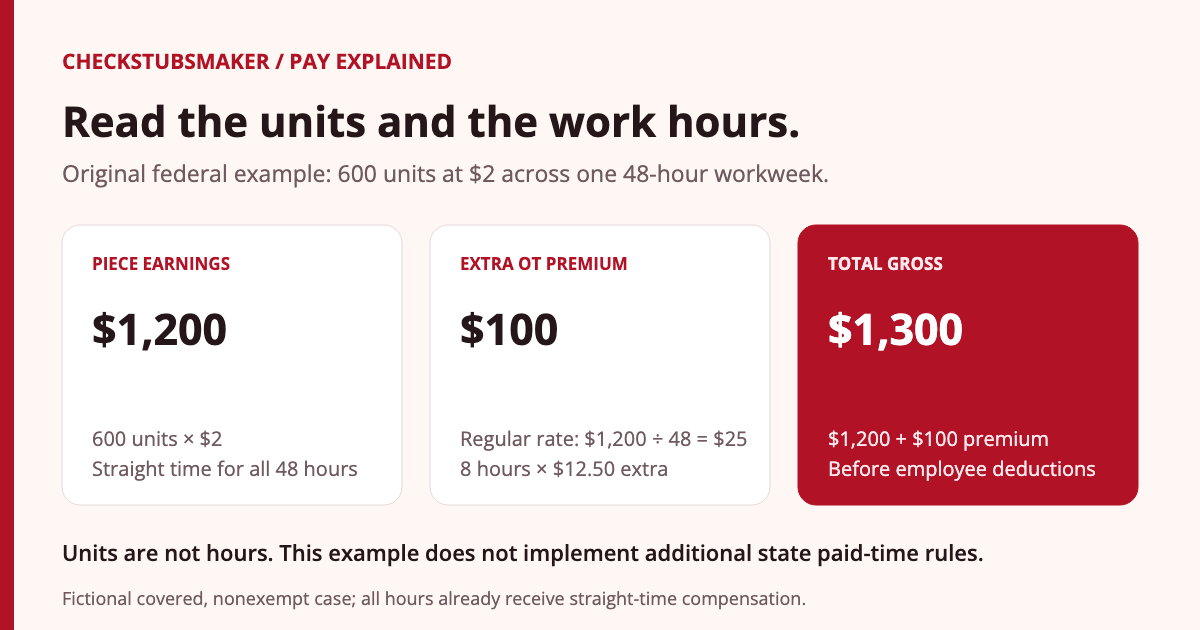
Cross-check the same total as 40 × $25 = $1,000 and 8 × $37.50 = $300, giving $1,300. Adding another full $300 to the $1,200 piece earnings would count the overtime hours’ straight-time compensation twice.
The 600 units and 48 hours remain separate quantities throughout. The $25 regular rate is derived for this assumed workweek; it is not a new agreed piece rate. A different mix of includable earnings, hours, or guarantees changes the analysis.
The $1,300 is gross earnings, not an automatic bank deposit. Employee taxes and other deductions require their own payroll treatment. See gross versus net pay.
Can state rules require more than this federal illustration?
Yes. For example, the California Department of Industrial Relations piece-rate FAQ explains separate compensation requirements for rest and recovery periods and other nonproductive time under California law. Those details should not be replaced with the article’s simplified federal example.
Check the requirements that apply to the actual location, occupation, and work arrangement. A correct multiplication of units by rate does not alone establish correct pay for all time, overtime, or required wage-statement fields.
If a statement combines hourly and piece earnings, ask how each compensated period and includable amount entered the calculation. Do not drop hourly entries merely because the main compensation method is piecework.
What should you ask about an unexplained piece-rate payment?
- Confirm the unit definition and rates for the affected work.
- Match production records with quantities included in payroll.
- Identify actual hours by workweek and other paid-time components.
- Ask for the minimum-wage, regular-rate, and overtime calculations that apply.
- Request an employer-issued correction for an actual discrepancy and preserve the original records.
A focused request is: “Please reconcile my [pay date] piecework earnings with the unit counts and rates, workweek hours, other paid-time amounts, and overtime calculation for [dates].” See requesting a payroll correction and organizing wage-dispute records.
Frequently asked questions
Are piece units the same as hours?
No. The output quantity and actual work time measure different things.
Does piece-rate pay automatically eliminate overtime?
No. Review the rules for the actual employment. The ordinary covered, nonexempt federal framework can require additional overtime pay.
Can I calculate every pieceworker’s pay using this example?
No. It uses specific assumptions. Other earnings, guarantees, paid time, state rules, and special arrangements need review.
Does the regular hourly rate replace the agreed piece price?
No. The example derives an hourly regular rate for the weekly overtime calculation; the piece rate still describes payment per unit.
Should I compare the production amount directly with my deposit?
First identify all earnings and employee deductions. Piece earnings alone need not equal the final net payment.
Prepared by the CheckStubsMaker Editorial Team using primary federal and California sources with original arithmetic. See our editorial policy. The example does not decide an individual wage claim.