A reimbursement on a pay stub generally records money paid back for an expense, but the label alone does not establish its tax treatment. A qualifying accountable-plan reimbursement can be excluded from wages and added to the cash payment. A nonaccountable allowance can be taxable pay. Match the payroll entry with the approved expense report, payment record, and employer’s explanation.
For U.S. employees · Sources checked November 14, 2026 · This guide explains expense-payment records and general federal distinctions. All amounts in the examples are fictional. It does not decide whether an individual expense qualifies or what an employer must reimburse.
Your deposit can be larger than your net wages because payroll also returned money you spent on an approved business expense. That increase is different from a raise or bonus. Conversely, a line called reimbursement is not automatically outside taxable wages. The arrangement and supporting records matter.
Which records explain a reimbursement entry?
Start with the exact code, amount, payment date, and current-versus-YTD heading. Then locate the related expense-report number and approval record. Payroll may use a separate payment, combine it with wages, or route the payment through an accounts-payable system.
These are possible processing arrangements, not a promise that your employer offers each route. Ask which system actually issues the money and which statement explains it.
| Record | Useful information | What it does not establish alone |
|---|---|---|
| Expense report | Dates, business purpose, submitted amounts, reference | Final approval or payment |
| Approval notice | Accepted expenses, adjustments, payment instruction | That money has reached the account |
| Payroll or payment advice | Amount issued, deductions or offsets, destination | Every underlying receipt and business purpose |
| Bank transaction | Amount and posting date received | The tax classification of the payment |
For a split deposit, add the relevant payment destinations before comparing totals. Our pay-stub and bank-statement comparison explains why the payroll record and account transaction answer different questions.
When can an expense reimbursement be outside wages?
IRS Publication 463, chapter 6, describes an accountable arrangement through three requirements: a business connection, adequate accounting within a reasonable period, and timely return of excess amounts. Specific expense and substantiation rules still matter.
The IRS distinguishes qualifying accountable-plan payments from nonaccountable arrangements. A nonaccountable reimbursement or allowance is generally included in pay; an employee cannot convert that arrangement merely by voluntarily providing receipts. Ask payroll which arrangement applies.
The 2026 Employer’s Tax Guide also addresses reimbursement treatment. Do not assume that a recurring flat allowance, a payment replacing salary, and reimbursement of documented business costs all have identical payroll consequences.
A receipt helps support an expense, but it is not the whole classification test. Personal costs, unsupported amounts, or excess advances need their own review. Our stipend guide explains why the payment’s purpose matters more than its label.
Example: reconciling wages, expenses, and a $2,080 deposit
Assume an employee has $2,400 cash wages and $500 total employee deductions. Separately, the employer approves $160 of lodging and $20 of parking from a business trip. For this illustration, assume both expenses meet the applicable accountable-plan rules, the employee already paid them, and the full $180 reimbursement is excluded from wages.
Assume payroll sends the wage net and reimbursement together to one bank account, with no advance, noncash item, credit, or other adjustment. The $500 deduction total is an assumed input, not a tax calculation.
| Component | Calculation or meaning | Amount |
|---|---|---|
| Cash gross wages | Given earnings | $2,400.00 |
| Employee deductions | Assumed total | −$500.00 |
| Net wages | $2,400 − $500 | $1,900.00 |
| Approved reimbursement | $160 lodging + $20 parking | +$180.00 |
| Total payment | $1,900 + $180 | $2,080.00 |
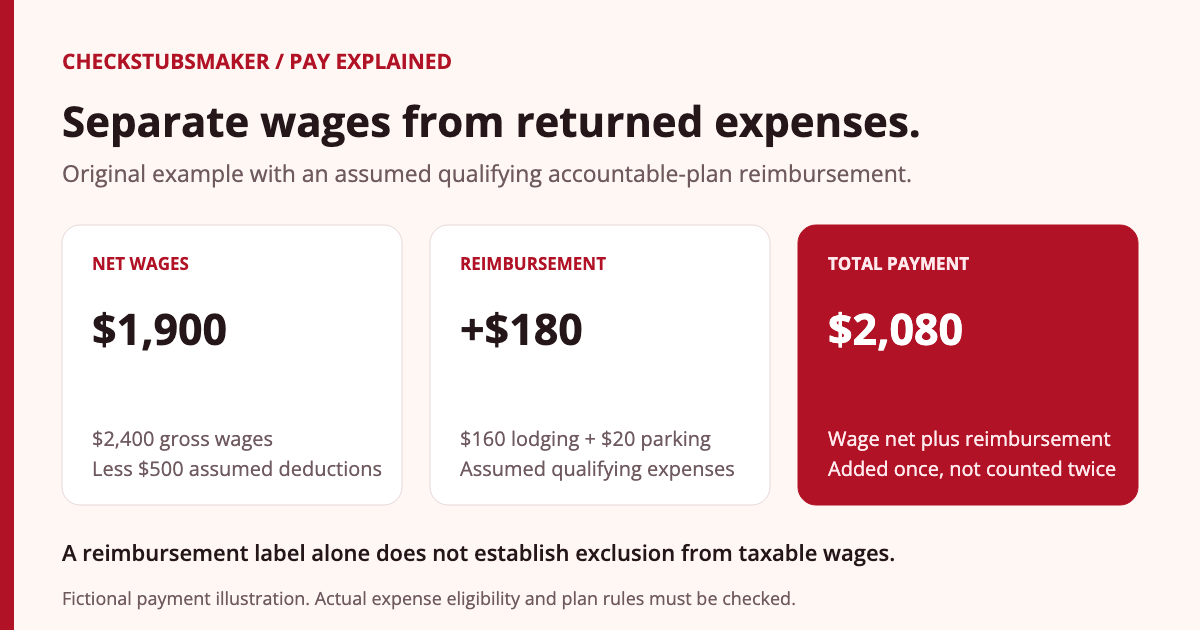
The employee receives $2,080, but it would be misleading to treat that amount as gross wages. It would also be wrong to add the $180 again if starting from the final $2,080 payment. Read the field definitions before applying any formula.
A different payroll system may show the expense payment elsewhere on the statement, or issue it separately. Under the same facts, a $1,900 wage deposit plus a separate $180 expense deposit would reach the same total. Use gross versus net pay to separate earnings, deductions, and other payment adjustments.
How is a travel advance different from reimbursement after the trip?
An advance supplies money before the expenses are fully settled. A later expense report explains what was spent and what remains outstanding. Do not assume an approved report means the entire report total must be paid again when an advance already covered it.
For an original illustration, assume a $250 business-travel advance and $180 of qualifying expenses adequately accounted for after the trip. The difference is $70. Under the assumed accountable arrangement, the employee returns that excess within the applicable reasonable period through the employer’s specified process.
The $180 is not a second $180 cash entitlement in this example: it explains part of the original $250. Keep advance issuance, expense approval, excess return, and any additional payment separate in the ledger.
Do not infer that payroll may deduct any disputed advance from wages without considering applicable requirements. Ask the employer how settlement is authorized and recorded. The example explains accounting, not a universal wage-deduction permission.
What if the approved reimbursement is absent or smaller?
Compare the submitted total with the approved total first. An expense report may contain rejected items, a prior advance, a corporate-card charge paid by the company, or an amount already reimbursed. Each needs a distinct explanation.
Next confirm the actual payment channel and scheduled release. A payroll statement may not list an accounts-payable payment. An approval timestamp may precede issuance or bank posting. Ask the responsible team for the payment reference rather than immediately treating the statement as missing wages.
- Record the expense-report number, submitted amount, and approved amount.
- Identify any advance, corporate-card payment, or earlier reimbursement.
- Confirm whether payroll or another system issues the money.
- Match the amount, reference, destination, and payment status.
- Request a documented correction for a confirmed mismatch.
A focused question is: “Please reconcile expense report [reference], approved for [amount], with any advance or company-paid items and the actual payment method, date, and amount.” For an incorrect payroll entry, see the correction guide.
Which records should you keep?
Retain the expense report, required evidence, business-purpose information, approval, advance settlement, payment advice, and any correction. Keep the employer’s classification explanation when a wage amount is disputed. The IRS recordkeeping discussion in Publication 463 explains why expense support matters.
When estimating recurring salary or supplying income evidence, identify reimbursements separately and follow the recipient’s definition of income. Repayment of an expense should not silently become an assumed recurring raise in an annual projection. See our annual-income guide.
Frequently asked questions
Is everything labeled reimbursement tax-free?
No. The arrangement, expense eligibility, accounting, and treatment of excess payments matter.
Does a reimbursement always appear on my pay stub?
No. Ask whether payroll or another payment system issues the expense payment.
Can the deposit exceed net wages?
Yes. A separate expense payment included in the deposit can explain the difference. Check whether the displayed net amount already includes it.
Does submitting receipts automatically make a flat allowance accountable?
No. The employer’s arrangement and all applicable requirements must be considered.
Should an advance be reimbursed again after approval?
Do not assume so. Reconcile the approved expenses with money already advanced and any amount returned or still payable.
Prepared by the CheckStubsMaker Editorial Team using primary IRS guidance and original payment examples. See our editorial policy. Employer reimbursement duties and individual expense tax treatment require the relevant facts and rules.