A stipend on a pay stub is a payment label whose payroll treatment depends on what the money is for. Employee compensation generally belongs in taxable wages. A qualifying business-expense reimbursement can receive different treatment, while scholarships and grants have separate rules. Check the written arrangement, earnings code, taxable-wage bases, deductions, and final payment instead of assuming every stipend is tax-free.
For U.S. employees · Sources checked October 26, 2026 · All payment amounts below are fictional. The example assumes ordinary employee wages and a separate reimbursement meeting federal accountable-plan requirements.
A fixed allowance can sound like reimbursement even when payroll correctly treats it as wages. Conversely, an actual expense reimbursement can appear alongside wages without belonging in the same tax base. Identify each component before comparing the promised amount with the deposit.
What does stipend mean on an earnings statement?
The label may identify a fixed allowance or another payment under an employer’s arrangement. Read the full description and the written terms: what activity, service, expense, or period does it cover?
IRS Publication 525 explains the general inclusion of compensation for personal services in income. Calling employee compensation a stipend does not, by itself, create an exclusion.
Ask payroll whether the entry represents ordinary compensation, an expense payment, an adjustment, or something administered under separate program rules. A short earnings code does not answer all those questions.
Also identify whether the amount is recurring or one-time and whether it is stated before or after payroll deductions. A written promise of $200 gross is different from a promise of a specified cash amount after deductions.
Which different payments might be described as a stipend?
| Possible payment | What to establish | Useful record |
|---|---|---|
| Employee compensation or allowance | What services or compensation terms support the payment | Employment terms and payroll calculation |
| Business-expense reimbursement | Whether the arrangement and substantiation meet the relevant rules | Expense report, receipts, and reimbursement policy |
| Scholarship or fellowship payment | The award’s purpose, conditions, and applicable tax rules | Award agreement and institution’s explanation |
| Correction or catch-up payment | The original amount, covered period, and changed treatment | Earlier statement and adjustment explanation |
The same word can appear in different programs without giving all of them identical tax treatment. Avoid moving a payment into another category simply because that category would produce a larger deposit.
Our payroll-code guide explains how to request the full meaning of a short label.
When is an expense payment different from taxable wages?
IRS Publication 15 distinguishes accountable from nonaccountable reimbursement arrangements. An accountable plan requires a business connection, timely substantiation, and timely return of excess amounts. It must reimburse allowable business expenses rather than substitute for wages.
Qualifying accountable-plan reimbursements are not wages for the federal payroll taxes described in that publication. A nonaccountable expense allowance generally is wages and is treated as supplemental wages. The label “stipend” does not decide which arrangement exists.
A flat amount is not automatically excluded because the employee spent money on work-related items. Ask what policy applies and what documentation or excess-return process it requires. Some travel-allowance methods have specific rules; do not generalize one rule to every payment.
Keep any reimbursed expense separate from an ordinary wage calculation. If a combined payment includes wages and reimbursement, ask payroll to identify each component.
How can a stipend and reimbursement appear in one payment?
Assume a fictional employee earns $2,000 in regular wages and receives a $200 fixed cash allowance treated as ordinary taxable employee compensation under the arrangement. Total wage earnings are $2,000 + $200 = $2,200.
Separately, assume the employer reimburses $160 for approved business expenses under a plan meeting all accountable-plan requirements. The expenses are fully substantiated and no excess remains. There are no other payments or adjustments.
For this reading example, total employee tax withholding and after-tax deductions are assumed to be $400. There are no before-tax employee deductions. The $400 is not calculated from a W-4 or presented as a tax estimate.
| Entry | Treatment assumed for this example | Amount |
|---|---|---|
| Regular wages | Employee compensation | $2,000.00 |
| Taxable stipend or allowance | Additional employee compensation | +$200.00 |
| Total wage earnings | $2,000 + $200 | $2,200.00 |
| Employee deductions | Assumed withholding and after-tax total | −$400.00 |
| Wages remaining after deductions | $2,200 − $400 | $1,800.00 |
| Accountable-plan reimbursement | Separate qualifying expense payment | +$160.00 |
| Total cash payment | $1,800 + $160 | $1,960.00 |
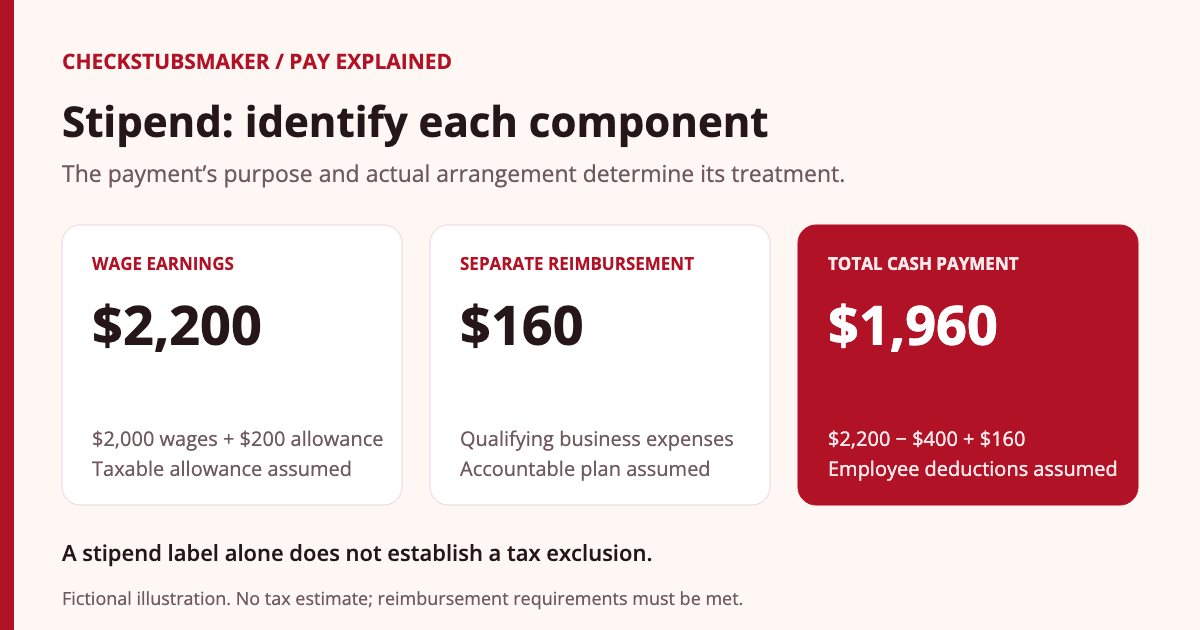
Some statements include reimbursement in their final net-payment figure; others show wage subtotals and a separate payment. Read the layout and match the final amount assigned to each destination.
The cash received is not automatically the federal wage base. In this example, the $160 qualifying reimbursement explains why total payment differs from wages remaining after deductions. Our gross versus net guide and deposit-reconciliation guide cover the payment comparison.
Why might the stipend’s net value be lower than its gross amount?
If the payment is employee compensation, applicable withholding and deductions can reduce the cash received. Payroll’s processing method also matters. A separately identified allowance can be subject to supplemental-wage rules rather than being processed exactly like ordinary salary.
Do not assume all supplemental payments use one withholding rate. Publication 15 describes different methods and conditions. Withholding is also separate from the final income-tax result on a return.
Compare the FITW entry, Social Security and Medicare entries, other applicable taxes, and actual employee deductions. If tax bases differ, use our taxable-wages guide and ask payroll for the calculation.
For benefits or retirement contributions, check how the relevant plan defines eligible compensation. A stipend code alone does not establish whether a particular plan contribution applies.
Are student, research, or fellowship stipends always tax-free?
No. IRS Topic 421 explains that scholarships, fellowships, and grants can be partly or wholly tax-free only when their requirements are met. The purpose and conditions of the award and use of the money matter.
A payment for teaching, research, or other required services needs particular review; the word “stipend” does not automatically make it a qualifying scholarship. The institution should explain what the payment represents and which records or tax forms it provides.
Do not apply an ordinary employee-payroll example to every academic or grant program. Retain the award agreement, service requirements, expense information, and any tax documents, and use the applicable IRS guidance for the actual program.
What should you ask payroll if a stipend entry seems wrong?
- Identify the purpose. What service, expense, or award does the amount support?
- Check the written amount. Is it gross compensation, an expense limit, an advance, or another defined payment?
- Confirm the classification. Ask why payroll treats it as wages, reimbursement, or a separately administered payment.
- Reconcile the calculation. Review the wage bases, withholding, deductions, reimbursements, and final payment.
- Check dates and running totals. Confirm the covered period and whether an adjustment changes YTD records.
- Request an official correction if needed. Preserve the original statement and written explanation.
A focused request could read: “Please explain the stipend entry of $[amount] on my statement dated [date], including its purpose, wage or reimbursement classification, withholding method, and effect on the final payment.”
Use the pay-period and pay-date fields to identify the correct record. For an error, follow our correction guide. Save supporting agreements, expense records, and statements using an appropriate retention period.
Frequently asked questions
Is every stipend tax-free?
No. The actual purpose and applicable rules determine treatment, not the payment’s name.
Is a stipend the same as reimbursement?
Not necessarily. A payment treated as wages differs from a reimbursement meeting the relevant expense-plan rules.
Does spending a cash allowance on work items make it tax-free?
Not automatically. Review the arrangement, required substantiation, and applicable rules.
Should my deposit equal the stipend amount in an agreement?
Check whether the agreement states a gross or net amount and whether the deposit includes other wages, deductions, or reimbursements.
Does a student stipend follow the same rules as employee salary?
Not in every case. Ask the institution what the payment represents and review the rules for that award or employment arrangement.
Prepared by the CheckStubsMaker Editorial Team using the primary sources linked above and original examples. See our editorial policy for sourcing and correction standards. Classification and tax treatment depend on the actual arrangement, supporting records, and applicable rules.