An RSU offset on a pay stub is an employer-specific entry associated with restricted stock unit compensation. It can help reconcile stock-plan activity with the payroll calculation, but the name alone does not establish whether it represents delivered share value, tax funding, or another adjustment. Match the entry with the award’s income, withholding, and settlement records before deciding what it means for cash pay.
For U.S. employee stock-plan participants · Sources checked October 29, 2026 · The fictional example assumes vesting and stock delivery occur together. Deferred settlement and special awards require separate review.
A stock award can increase compensation reported through payroll without creating an equal checking-account deposit. That does not mean every offset is correct or every cash paycheck stays unchanged. The calculation and the plan records have to explain the result.
What RSU event is the statement recording?
An RSU is a promise of a future stock- or cash-based payment under an award arrangement, rather than an immediate issue of shares at grant. Fidelity’s RSU help guide explains that the plan and grant agreement govern vesting and distribution, which may occur on different dates.
Identify the award, vesting date, delivery date, number of units, and settlement method. A grant summary showing unvested units is different from a completed delivery transaction.
The IRS equity-compensation audit guide distinguishes RSUs settled in stock from those settled in cash and discusses income when stock is transferred. It is explanatory audit material, not a ruling on an individual award. This article uses a simplified stock-settled event, not a general timing rule for every plan.
Why is the exact offset label not enough?
Read all associated rows together. Ask payroll which amount enters compensation, which rows record tax withholding or credits, and which adjustment removes a value already handled through the stock plan from the cash-payment calculation.
Do not infer that the offset is an additional tax, a fee, the full award value, or the net share value solely from its wording. Request the employer’s definition and a numerical reconciliation. The example below demonstrates one possible layout; it is not a universal payroll code legend.
| Component | Question to answer | Supporting record |
|---|---|---|
| Compensation income | What event, quantity, and valuation support the amount? | Award and delivery confirmation |
| Tax withholding | How much was recorded and how was it funded? | Payroll tax detail and stock-plan transaction |
| Offset or adjustment | What value does this employer’s code remove or reconcile? | Payroll explanation of the full calculation |
| Delivered shares or cash | What actually reached the stock-plan or bank account? | Brokerage activity or cash-payment record |
Use the current event rather than a YTD amount when reconciling one settlement. Our YTD guide explains the difference.
Are shares withheld and shares sold to cover the same transaction?
They are different methods. Fidelity’s guide describes net-share withholding, a sale of shares to cover withholding, and cash funding, depending on the plan. Withholding shares reduces the shares delivered; selling to cover creates a sale transaction. Cash funding uses money from the permitted source.
Ask which method actually applied. Do not label every reduction in delivered shares a broker sale, or assume a zero bank deposit means no value was delivered. Fees, rounding, residual cash, and later adjustments must be read from the actual confirmation.
The funding method also does not establish the final tax liability. Schwab’s restricted-stock guide explains that employee RSU compensation and later share sales involve distinct tax considerations and that withholding can differ from the final result. No fixed withholding rate is assumed here.
How can RSU income appear without an additional cash paycheck?
Assume 100 fictional RSUs vest and settle in shares on the same date, with an employer-assigned value of $40 per share. The employee paid nothing for the award. Compensation for this event is 100 × $40 = $4,000.
Assume the plan withholds 30 shares to fund exactly $1,200 of employee tax withholding and delivers the remaining 70 shares. All shares are valued at $40 for this illustration. There is no share sale, fee, rounding, residual cash, deferral, or other adjustment.
The $1,200 is an assumed withholding amount, not a calculated or recommended tax rate. This employer’s hypothetical payroll layout uses an offset equal to the delivered shares’ $2,800 value.
| Event component | Illustrative calculation | Amount |
|---|---|---|
| RSU compensation | 100 shares × $40 | $4,000.00 |
| Tax withholding | 30 shares × $40; assumed funding | −$1,200.00 |
| Delivered-share offset | 70 shares × $40; this layout only | −$2,800.00 |
| Additional payroll cash | $4,000 − $1,200 − $2,800 | $0.00 |
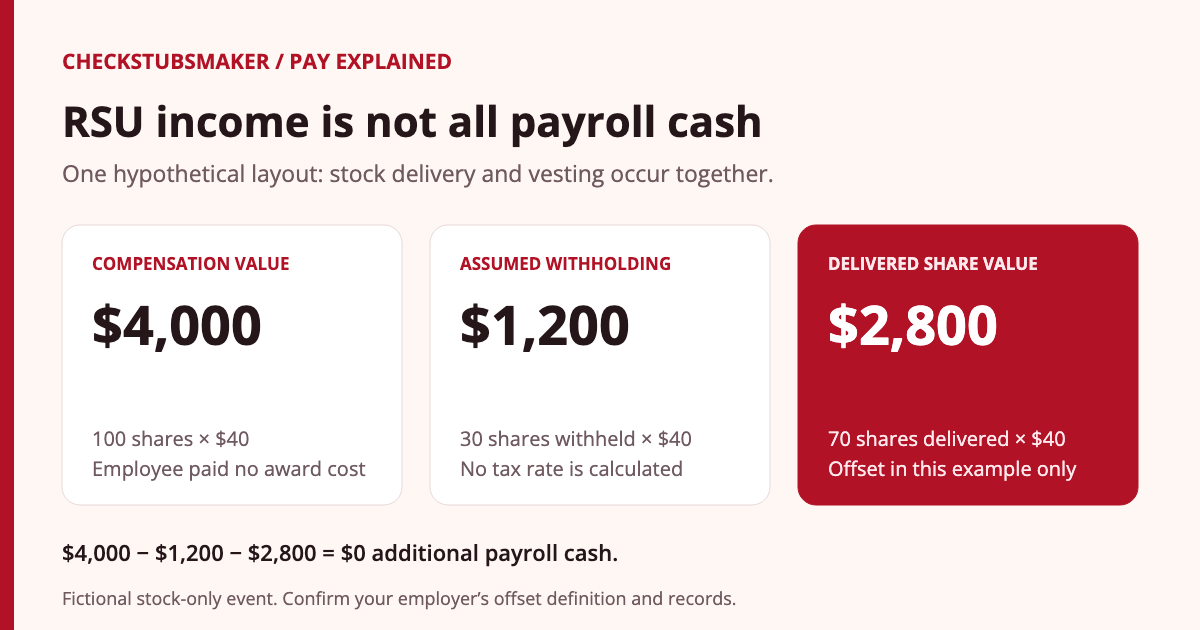
The 70 delivered shares still have value; they are not a $2,800 bank deposit. The offset reconciles that stock delivery in the hypothetical cash calculation. It does not erase the $4,000 compensation amount.
Does an RSU event always leave salary take-home pay unchanged?
No. The example isolates one stock-only event and says nothing about a separate salary payment. Your actual statement may combine wages and equity activity or record them separately.
Reconcile ordinary cash earnings, employee deductions, stock compensation, stock-plan funding, and noncash adjustments as separate components. If payroll takes additional withholding from salary, the cash result can differ from an example funded entirely through shares.
For the account comparison, use pay stubs versus bank statements. For a broader explanation of noncash earnings, see imputed income on a pay stub. Do not assume every noncash entry follows identical tax rules.
Which tax and stock-plan records should you retain?
Keep the grant agreement, delivery confirmation, withholding detail, pay statements, and relevant year-end tax documents. If shares are sold, retain the sale confirmation and basis information as well.
Schwab’s guide distinguishes compensation reported for employees from the gain or loss on a subsequent sale and emphasizes cost-basis records. A brokerage sale record and a payroll earnings record are not interchangeable.
Do not use an offset label as a shortcut for deciding a sale’s basis or editing a tax form. Reconcile the employer’s and broker’s records and request corrections where needed. Our pay-stub and tax-filing guide explains why a payroll statement does not replace the appropriate annual forms.
What should you ask payroll about a confusing RSU offset?
- Identify the event. Confirm grant identifier, dates, quantity, and whether settlement was stock or cash.
- Verify the valuation. Ask which price and valuation date support payroll compensation.
- Trace withholding funding. Separate shares withheld, shares sold, and cash collected.
- Define the offset. Request the exact code meaning and its place in the cash calculation.
- Match the delivery. Compare the stock-plan quantity or cash with the confirmation.
- Preserve the explanation. Request a documented correction for an actual discrepancy.
A focused request is: “Please reconcile the RSU entries for [event/date], showing gross compensation, withholding, funding method, offset definition, delivered shares, and any impact on salary cash.”
Frequently asked questions
Is an RSU offset always the tax withheld?
Do not assume that. Ask what the employer’s particular code represents and reconcile the associated rows.
Does a noncash offset remove RSU compensation from taxable income?
Not merely because it appears in the cash calculation. Review the actual compensation treatment and award rules.
Are net-share withholding and sell-to-cover identical?
No. One withholds shares; the other sells shares. Check the plan transaction.
Why did I receive fewer shares than the number that settled?
Compare the gross quantity with shares withheld or sold, fees, and other documented adjustments.
Is zero additional payroll cash proof that an award was not paid?
No. Review whether value was delivered in shares or through another documented destination.
Prepared by the CheckStubsMaker Editorial Team using primary IRS and stock-plan provider sources and an original illustration. See our editorial policy. The offset example is an accounting illustration, not a claim about a universal code or an individual award’s tax outcome.