On an education employee’s pay stub, TRS commonly refers to a Teacher or Teachers Retirement System contribution. Confirm the state, retirement system, employee contribution rate, and eligible compensation used by payroll. The same abbreviation can refer to different systems. A pension contribution, an employer contribution, and a retiree-health contribution are separate entries and should not be combined without checking their purpose.
For U.S. education employees · Sources checked November 3, 2026 · The worked example uses published Texas rates and assumed compensation. It does not apply those rates to employees in another system.
Start with the full retirement-plan name on your enrollment materials or employer benefits page. “TRS” identifies a place to investigate; it is not enough information to select a rate or calculate a future pension.
What does TRS stand for on your statement?
Examples include the Teacher Retirement System of Texas and the Teachers Retirement System of Georgia. They are different systems with their own rules.
Confirm that the line is a retirement contribution and identify the particular plan. An unfamiliar abbreviation should be read with the employer’s payroll legend, as explained in our deduction-code guide.
Also identify whether the statement belongs to an active employee or records a retirement payment. A deduction from active employment and withholding from a retiree’s benefit statement answer different questions.
Which TRS-related amounts should you keep separate?
| Entry | Question | Record to compare |
|---|---|---|
| Employee pension contribution | What is being deducted for retirement? | Member rate and eligible compensation |
| Employer or state contribution | Is this another party’s funding amount? | Employer contribution explanation |
| Retiree-health contribution | Does this fund a separate health program? | Program-specific rules and exceptions |
| Current and YTD columns | Is this one period or an accumulated total? | Prior statement and contribution history |
Do not subtract an informational employer amount again when reconciling net pay. Likewise, do not assume that every TRS-related deduction belongs in the member’s pension account.
Is the contribution rate the same in every state?
No. The Texas TRS contribution-rate page lists an 8.25% member retirement contribution and a separate 0.65% member TRS-Care contribution for 2026–2027. The Texas Comptroller also confirms the 8.25% employee pension rate for fiscal 2026 and 2027.
By comparison, Georgia TRS’s published FY 2027 notice lists a 6.00% employee rate effective July 1, 2026. This comparison demonstrates why an internet search for “the TRS rate” needs a state and effective period.
Use the rate that actually applies to your membership and pay period. For older statements, check the historical rate rather than using today’s figure. Ask whether an unusual line includes a correction or another type of contribution.
How would the Texas deductions work on $4,000?
Assume a fictional active Texas public-school employee has $4,000 of compensation eligible for both contributions in the example. Assume the employee is subject to the TRS-Care member contribution and has no correction, refund, or other adjustment.
| Contribution | Calculation | Amount |
|---|---|---|
| Member pension | $4,000 × 8.25% | $330.00 |
| Member TRS-Care | $4,000 × 0.65% | $26.00 |
| These two employee contributions | $330 + $26 | $356.00 |
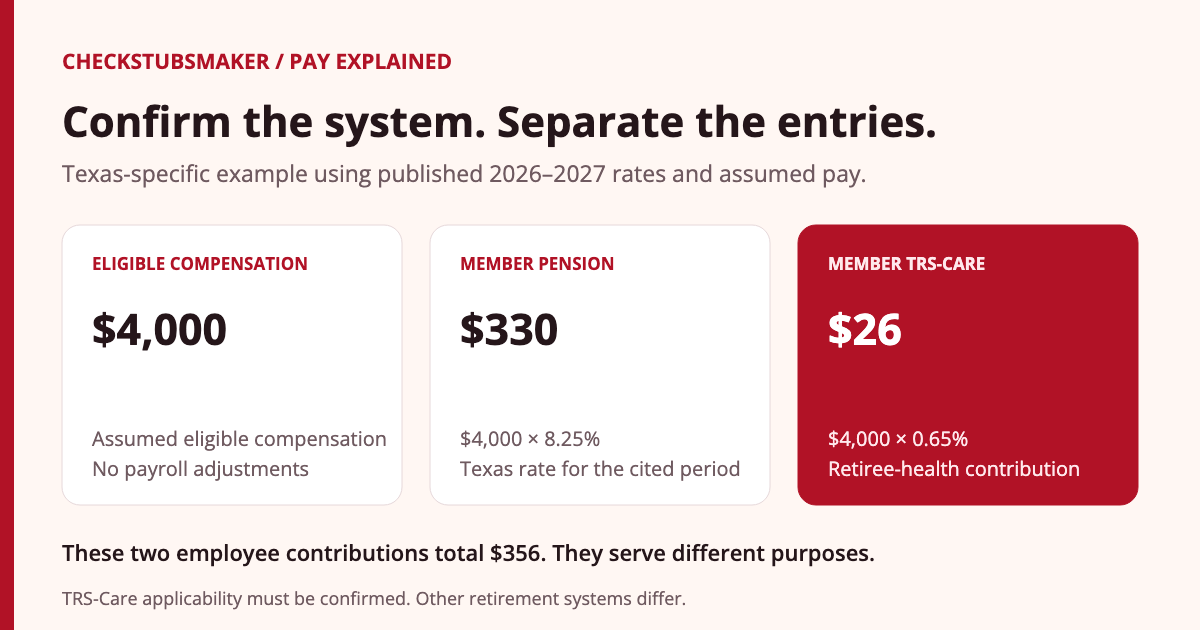
The Texas new-member FAQ explains that TRS-Care supports the retirees’ health program and is not deposited in the member pension contribution account. It identifies exceptions for employees entitled to certain other public-system health coverage. Confirm applicability before using the second row.
The $330 pension deduction does not mean the employee will receive a $330 retirement payment. Texas TRS describes its pension as a defined-benefit arrangement with benefits determined by a legal formula.
Why might your calculation differ from the pay stub?
First check the base. Eligible or creditable compensation need not be identified simply by selecting the largest earnings total on the statement. Texas TRS provides compensation definitions and links to its eligibility guidance in the new-member FAQ.
Ask payroll to show the earnings included, the applied rate, and any adjustment separately. Then calculate:
Confirmed eligible compensation × applicable member rate = contribution before identified adjustments.
For example, at the same Texas pension rate, $2,000 × 8.25% = $165. That smaller amount can be correct for a smaller eligible-compensation base; it does not establish that the employer changed the rate. Confirm the actual periods and earnings.
Texas’s member-contribution page describes pension deductions as pre-tax. Do not extend that description automatically to every related deduction or every tax wage base. Our taxable-wages guide explains why gross earnings and taxable amounts can differ.
How do you compare payroll with your retirement account?
Obtain the official account record through your retirement system. Compare its reporting period with the payroll periods in your statements, and separate pension contributions from other deductions before totaling them.
For a simple check, if a prior pension YTD total is $990 and the current pension contribution is $330 with no adjustment, the new payroll YTD total would be $1,320. That arithmetic does not prove that an account posting is complete; ask the employer or system to identify which reported periods the account includes.
Do not add a retiree-health line to that pension-only total. Our YTD guide can help organize the payroll side of the comparison.
What should you ask if the TRS amount looks wrong?
Send payroll a focused request: “For [pay date], please identify the retirement system and contribution type for [label], show the eligible-compensation base and rate, and explain any adjustment. Please also confirm which period was reported to the retirement system.”
Keep the statement, your calculation, and the response. A payroll question and a pension-benefit question may need different offices. For a confirmed statement error, request a correction; our correction guide explains how to document the issue.
If you also have a separate workplace savings plan, identify it independently. A 401(k) contribution should not be assumed to have the same rules as a TRS pension deduction.
Frequently asked questions
Is TRS a federal tax?
In the retirement context, it is a retirement-system entry rather than the name of a federal tax. Confirm the actual employer code.
Is every TRS member contribution 8.25%?
No. That is the cited Texas rate for the stated period. Other systems and periods can differ.
Does TRS-Care go into the Texas pension contribution account?
The Texas FAQ says that this separate health-program contribution does not go into that account.
Should I subtract the employer’s contribution from my pay?
Verify the heading. An employer funding amount is separate from the employee deduction.
Can a paycheck deduction tell me my future pension?
No. Use the actual system’s benefit rules and official estimate process.
Prepared by the CheckStubsMaker Editorial Team using official retirement-system and state-payroll sources with original calculations. See our editorial policy. This guide does not determine membership, pension eligibility, a refund, or an individual tax result.