Your first pay stub becomes available when the employer issues the statement for your first processed payroll. Confirm the first pay date, period covered, and statement-release timing with payroll. Portal registration, time approval, statement publication, and payment are separate events; there is no universal rule that every employee can view a stub a fixed number of days before payday.
For U.S. employees · Sources checked November 11, 2026 · Availability and legal statement requirements depend on the employer, work arrangement, and applicable law. All dates and earnings in the example are fictional assumptions.
A new employee can have an active payroll account before any statement appears. The useful question is whether the first payment has been processed and which document should be visible, rather than whether registration alone is complete.
Which dates determine the first statement?
Ask for the employer’s payroll calendar and the first period containing your work. Identify the processing cutoff, expected statement publication, and scheduled payment separately.
| Event | What it answers | Useful confirmation |
|---|---|---|
| Employment start | When did employment begin? | Employer’s accepted start date |
| Pay-period end | Which work dates are included? | Payroll calendar and time record |
| Processing cutoff | Which approved inputs enter this payroll? | Payroll’s instructions and approval status |
| Statement release | When can the document be viewed? | Employer’s confirmed publication timing |
| Pay date | When is the payment scheduled? | Payment method and payroll calendar |
A pay date after the work period is not by itself an unexplained delay. Compare it with the agreed schedule and applicable requirements. See our pay-period versus pay-date guide.
Can you view a stub before the first paycheck?
Sometimes the employer publishes it before the payment date; ask about the actual release process. An empty portal can also mean the statement has not yet been released, the account needs linking, or the employer uses another delivery method.
ADP’s employee-access guidance, as one provider example, explains that access depends on the employer providing it and that registration information comes from the employer. It does not establish one statement-release deadline for all employers.
Use the official portal and authorized account-recovery process. Confirm the correct employer profile if an old job also appears. Do not assume that a successful login guarantees a statement already exists.
Our direct-deposit statement guide explains why the payment and payroll document need separate checking.
Example: a statement covering only the new employee’s first week
Assume a fictional employer’s period runs October 26–November 8, 2026, with payment scheduled for November 13. The employee starts November 2 and records 40 properly classified regular hours at $25 per hour during the included dates.
Assume payroll confirms that the statement will be released November 12. The dates illustrate this employer’s stated process, not a universal legal or provider rule.
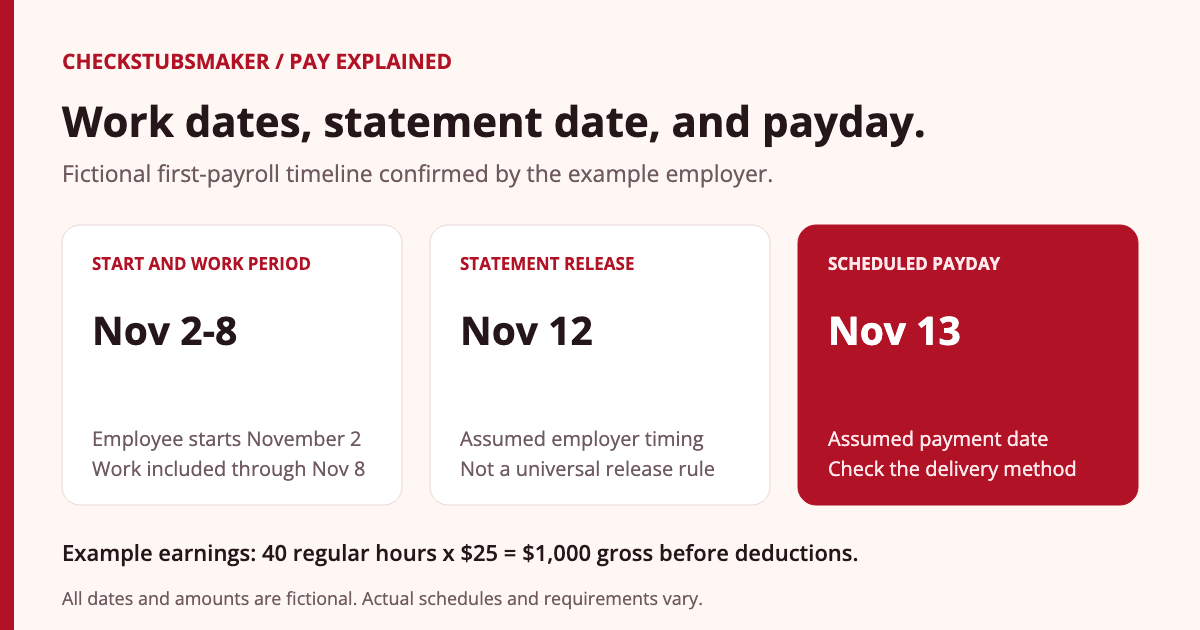
Regular gross earnings are 40 × $25 = $1,000 before applicable taxes and employee deductions. The employee should not expect 80 hours merely because the employer’s full period spans two weeks.
This calculation does not determine a salary proration, overtime classification, withholding, or net payment. Our hours guide and gross-versus-net guide cover those separate fields.
Why might the first paycheck be smaller or different?
Compare the actual employment dates and included earnings. A first period can be shorter than a normal period. There may also be benefit effective dates, approved time changes, or a separate payment needing explanation.
For salary, request the employer’s actual calculation instead of inventing an hourly or calendar-day proration. A familiar annual salary divided by the normal number of payments may not explain a partial first period.
When the first statement arrives, check the name, employer, dates, hours or salary entry, applicable deductions, and payment destinations. Keep the original and note any difference from the employment and time records.
Is there a federal deadline for every first pay stub?
The Department of Labor’s FLSA FAQ distinguishes employer recordkeeping from furnishing employee pay stubs: the FLSA requires covered records but does not itself require pay stubs. That does not resolve state requirements or special coverage.
The DOL state payday overview illustrates that payment-frequency rules vary. Check the relevant labor agency’s current rules for the actual jurisdiction and work category; do not use a generic internet release estimate as a legal deadline.
If the expected payday has passed without payment, report the payment issue as well as the missing document. If the money arrived but the statement is unavailable, identify that distinction. See requesting missing pay stubs.
What should you ask payroll before following up again?
A useful request is: “My start date is [date]. Please confirm the first pay date, included work dates, statement-release date, and delivery method. Is any time approval or account action still outstanding?”
If a confirmed release date passes, provide the employer profile, pay date, and what the portal shows. Ask for the statement or an official explanation and keep the response. Our correction guide helps document the issue.
If another organization needs income evidence before the first statement exists, ask what it accepts. An offer letter or employer response may support particular facts, but it is not automatically an issued pay stub.
Frequently asked questions
Does portal registration create my first pay stub?
No. Confirm that payroll has processed and released the relevant statement.
Can a statement appear before payday?
It can under an employer’s process. Ask for the actual release timing.
Does a two-week period mean my first payment includes two weeks of work?
Not if employment began partway through it. Check the actual included dates.
Is a missing statement the same as a missing payment?
No. Report which item is missing and check each separately.
Can I assume every employer follows the same deadline?
No. Confirm the schedule and applicable legal requirements.
Prepared by the CheckStubsMaker Editorial Team using primary labor and provider guidance plus an original payroll timeline. See our editorial policy. No individual payday, legal deadline, or payroll result is determined.