A monthly pay schedule has one regular payroll payment each month, normally 12 per year. It differs from semimonthly pay, which has two payments per month. Confirm the employer’s pay-period dates, scheduled payday, and any separate adjustments; “monthly” does not mean every four weeks or always the last day of the month.
For U.S. employees · Sources checked November 10, 2026 · Examples assume an agreed full-year salary paid in 12 equal regular installments. Actual payment frequency, partial-period treatment, and wage-payment requirements depend on the employment and applicable rules.
Understanding the schedule helps you read the statement, check a salary installment, and plan the interval before the next payment. It does not by itself establish hours worked, overtime treatment, or take-home pay.
How many payments does monthly payroll produce?
IRS Publication 15-T treats monthly and semimonthly as different payroll periods, using 12 and 24 periods per year respectively in its regular frequency framework. A monthly schedule should not be read as twice-monthly pay.
| Term | Meaning | Check |
|---|---|---|
| Monthly | One regular payment each month | Employer’s 12-payment calendar |
| Semimonthly | Two regular payments each month | Employer’s two scheduled dates |
| Pay period | Dates represented by the payroll calculation | Start and end dates on the statement |
| Pay date | Scheduled date for the payment | Payroll calendar and payment record |
| Separate payment | An additional payment or correction outside regular payroll | Its own statement and treatment in YTD totals |
A bonus, correction, or replacement payment can add a transaction without changing the regular schedule. Read our biweekly and semimonthly comparison for other frequency differences.
Does monthly pay cover the same calendar month?
Ask the employer. A payment in one month may represent an earlier work period, and the statement should be interpreted using its actual dates. A regular payday may also have specific weekend or holiday handling.
For example, a fictional payment on November 10 could cover October 1–31 if that is the employer’s confirmed arrangement. Do not relabel it as November work merely because the money arrived in November.
Request the annual payroll calendar, statement-availability timing, and any cutoff that affects time entries or changes. The pay-period versus pay-date guide explains the distinction.
Payment frequency is also a legal question. The Department of Labor’s state payday overview shows that frequency requirements vary and can depend on worker category. Check the applicable labor agency’s current rules; a monthly option is not automatically permitted for every worker.
Example: converting a fixed annual salary to monthly gross pay
Assume a fictional employee has a $72,000 annual salary that the agreement distributes in 12 equal full-month regular installments. Assume no partial period, unpaid time, bonus, or correction.
| Item | Calculation | Amount |
|---|---|---|
| Annual salary | Given agreement | $72,000.00 |
| Regular installments | One per month | 12 |
| Full-month gross installment | $72,000 ÷ 12 | $6,000.00 |
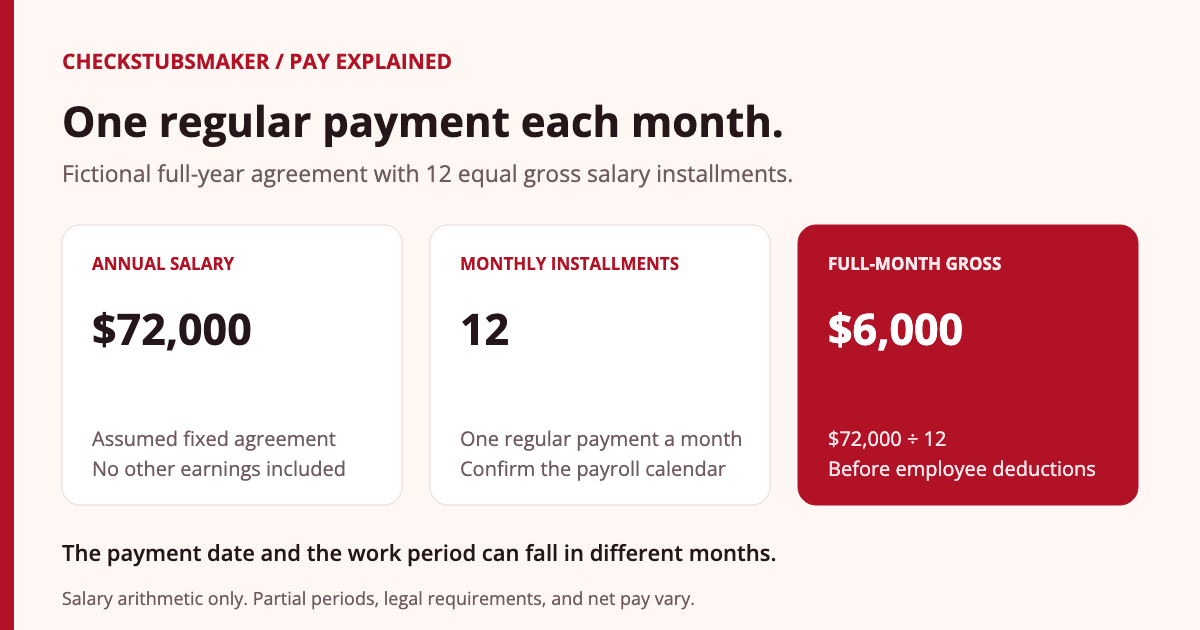
Dividing $6,000 by four does not establish an actual weekly wage. Calendar months are not all four weeks long. Also, a displayed salary-hour figure is not automatically the employee’s actual hours worked.
Our hours guide and gross-versus-net guide help investigate those separate questions.
Why might the first or last monthly payment differ?
Compare the employment start or end date, covered period, salary effective date, leave treatment, and any separate adjustment. A first statement may cover only part of a period or may include a catch-up amount.
Ask payroll to explain the actual proration method and authority for any deduction. Do not choose a calendar-day, workday, or hourly method merely because it produces a plausible number. The correct treatment depends on the arrangement and applicable requirements.
If the schedule changes during the year, request a transition calendar. Identify any gap or overlapping dates and ask how earlier YTD amounts are carried forward. A frequency change should be reviewed using the specific payroll records, not only the number of deposits.
How do you check deductions and net pay?
Review each employee deduction under the actual monthly arrangement. A benefit schedule may collect contributions differently from a prior weekly or biweekly arrangement. Do not assume every old deduction is simply multiplied by four.
Check tax wages and withholding separately from salary division. A $6,000 gross installment does not establish a particular tax percentage or net deposit. Use the employer’s calculation and your applicable withholding information.
Compare net pay with all payment destinations. A split deposit can put only part of the net amount into one account. Our direct-deposit guide explains how to locate and reconcile the statement.
How can you plan between monthly payments?
The CFPB’s bill-calendar guidance describes listing amounts and due dates to see the month’s obligations. Add your confirmed pay date and use actual take-home pay rather than the annual salary figure.
Mark expenses that fall before the next scheduled payment. Keep a separate note of irregular expenses and any income that is uncertain. A recurring salary and a one-time bonus should not be treated as identical recurring resources.
If an expected payment is missing, compare the calendar and statement, then contact payroll promptly. Keep the relevant pay date, amount, and account details with the request. Our correction guide helps document a discrepancy.
Frequently asked questions
Is monthly pay the same as semimonthly?
No. Monthly normally means one regular payment per month; semimonthly means two.
Does monthly always mean payment on the last day?
No. Confirm the employer’s scheduled payday and its weekend or holiday policy.
Can I divide annual salary by 12?
For an agreed salary distributed in 12 equal full-month installments, that gives the regular gross installment. Partial periods and adjustments need separate review.
Does a larger installment mean higher annual pay?
Not necessarily. Compare the annual agreement and number of installments.
Will every month have the same net pay?
Not necessarily. Deductions, tax treatment, adjustments, and other payroll activity can change the result.
Prepared by the CheckStubsMaker Editorial Team using primary payroll-frequency guidance, consumer budgeting material, and an original salary example. See our editorial policy. Confirm employment-specific payment and deduction requirements with the appropriate source.