A cash bonus is generally taxable employee wages, but the amount withheld from a bonus paycheck is not a separate final “bonus tax.” Payroll may use supplemental-wage withholding rules. To check the payment, identify gross bonus earnings, federal withholding, Social Security, Medicare, other deductions, and the amount actually delivered.
For U.S. employees · Sources checked November 14, 2026 · Federal rules are summarized for 2026. The worked example assumes a qualifying flat-rate withholding method and ordinary covered wages; it is not a personal tax estimate.
A promised $1,500 bonus can produce a much smaller bank credit without the gross award having changed. The first question is whether the promise states a gross amount or a guaranteed net amount. The second is how payroll moved from that amount to your payment.
Where does a bonus appear on a pay stub?
Look for an earnings code such as bonus, incentive, award, or a more specific employer label. Confirm what it means with the award notice and payroll code legend. The statement might include the bonus with regular wages or show it on its own payment advice.
Check the current-period amount separately from the YTD bonus total. A $1,500 current award and $3,000 YTD bonus figure do not mean $4,500 was paid on this check. The running total may already include the current award. Our YTD guide explains that distinction.
| Record | What to check | Common mistake |
|---|---|---|
| Award notice | Gross or net promise, eligibility, amount, payment timing | Comparing a gross promise directly with a deposit |
| Pay statement | Bonus earnings and the employee deductions applied | Adding a YTD amount to current earnings |
| Payment record | All destinations for this payment | Looking at only one split deposit |
| Year-end wage statement | Applicable annual wages and withholding | Treating one check as the full tax-year result |
Why might federal withholding look higher on a bonus?
IRS Publication 15, section 7, treats bonuses as supplemental wages. For separately identified supplemental wages within the $1 million annual threshold, an employer that withheld federal income tax from regular wages in the current or preceding year can generally choose the permitted flat 22% method or the prescribed aggregate method.
The aggregate method calculates withholding using regular and supplemental wages together, then accounts for withholding already assigned to regular pay and relevant earlier payments. If the bonus is combined with regular wages without separately identifying the amounts, the combined payment is treated as a regular payroll payment for withholding.
Different rules apply to supplemental wages above $1 million in the calendar year: the excess is subject to 37% federal withholding under the 2026 rules. The thresholds and conditions matter; “every bonus is taxed at 22%” is not an accurate rule.
These are federal income-tax withholding methods. They do not include every payroll tax or establish the final income tax owed. For the basic fields, see FITW on a pay stub and paycheck tax lines.
Example: how does a $1,500 bonus become $1,055.25?
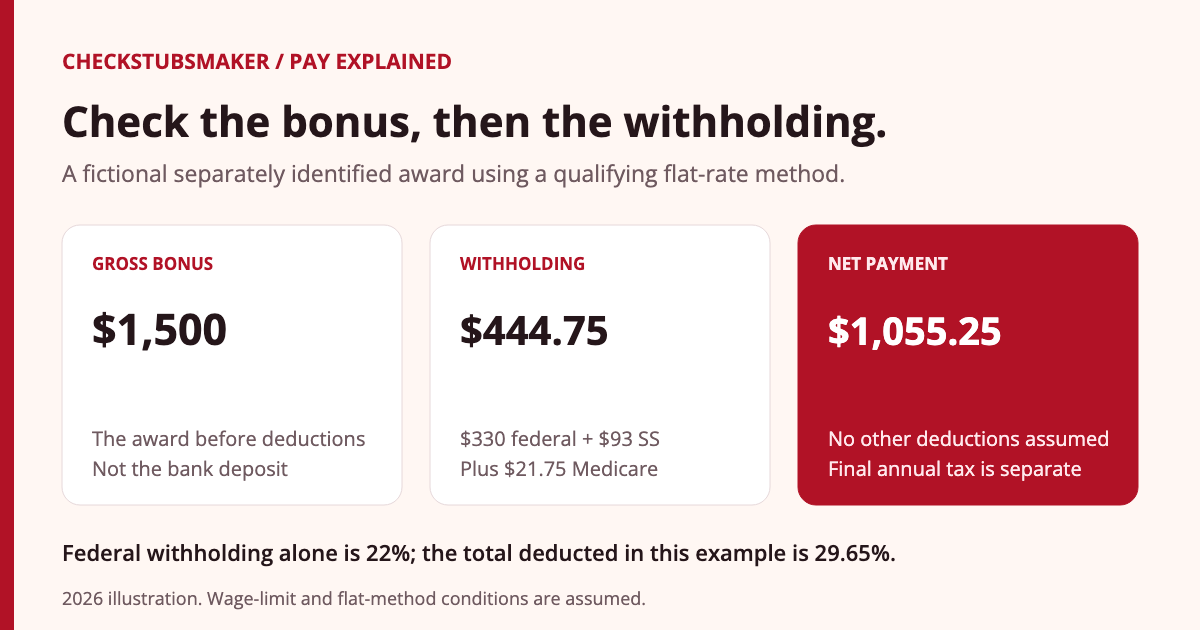
Assume a fictional employee receives a separately identified $1,500 cash bonus in 2026. The employer qualifies for and selects the flat 22% federal withholding method. Assume the whole payment is subject to ordinary employee Social Security and Medicare, remains below the Social Security wage base, and does not trigger Additional Medicare withholding.
For this limited illustration, assume no state or local withholding, retirement contribution, benefit deduction, reimbursement, or other adjustment. A real employee may have additional items.
| Line | Calculation | Amount |
|---|---|---|
| Gross cash bonus | Given award | $1,500.00 |
| Federal income tax withheld | $1,500 × 22% | −$330.00 |
| Employee Social Security | $1,500 × 6.2% | −$93.00 |
| Employee Medicare | $1,500 × 1.45% | −$21.75 |
| Total employee withholding | $330 + $93 + $21.75 | $444.75 |
| Net bonus payment | $1,500 − $444.75 | $1,055.25 |
IRS Topic 751 supplies the ordinary employee Social Security and Medicare rates. Social Security has a year-specific wage cap; Medicare and Additional Medicare have different rules. Do not apply the example blindly after a wage threshold is reached.
The full deduction share here is 29.65% of gross, even though federal income-tax withholding alone is 22%. Naming the numerator matters. Our deduction-percentage guide explains how to calculate and label the comparison.
What if regular wages and the bonus are on one statement?
Read the earnings rows before judging the deposit. If an employer reports $2,400 regular gross wages and a $1,500 gross bonus, the combined gross is $3,900. That does not mean the employee’s regular pay rate increased to $3,900 per period.
Check whether deductions are displayed for the combined payment or allocated to separate earnings. You may not be able to assign each dollar of a combined federal withholding line to the bonus by inspection. Ask payroll which method was used and for the reconciliation.
Retirement and benefit deductions need separate attention. Ask whether the plan’s compensation definition includes this award and whether any election applied. Do not assume a bonus check always excludes retirement contributions or always includes every regular benefit deduction.
For cash reconciliation, use gross versus net pay. For deciding whether a larger paycheck represents recurring income, use the annual-income guide and identify the bonus as a separate expected or completed payment.
Does a bonus put all your income into a higher tax bracket?
No. The IRS explanation of tax brackets describes a layered system: a higher marginal rate applies to the income in that layer, not automatically to all income. Additional taxable wages can affect the annual calculation, but the payroll withholding percentage is a different measure.
A return reconciles withholding with the tax calculated from the full year’s circumstances. The bonus check alone cannot establish whether you will receive a refund or owe a balance. Keep the statement and annual wage form, and use the IRS Tax Withholding Estimator when reviewing projected withholding within its stated scope.
What should you ask payroll if the bonus looks wrong?
- Identify the award notice and whether its amount was gross or net.
- Confirm the actual gross bonus, current pay date, and any installment schedule.
- Ask which federal withholding method was used and what other employee deductions applied.
- Match all payment destinations with the statement’s net payment.
- Request an employer-issued correction for an actual error and retain the explanation.
A focused request is: “Please reconcile the bonus on my [pay date] statement with the [award date] notice, including gross earnings, federal withholding method, other deductions, and payment destinations.” For a disputed statement, see how to request a payroll correction.
Frequently asked questions
Are bonuses tax-free because they are occasional?
Ordinary cash employee bonuses are generally taxable wages. The payment’s treatment follows the applicable rules, not how often it is paid.
Is 22% the total tax taken from every bonus?
No. It is one permitted federal withholding method under specified conditions. Other taxes and deductions may apply, and payroll may use another required or permitted method.
Does a smaller deposit prove my employer reduced the award?
No. Compare the gross earnings with the award notice, then reconcile deductions and payment allocations.
Can I infer my final tax bracket from the bonus stub?
No. One payment’s withholding does not determine your complete annual tax result.
Should I count a one-time bonus as regular salary?
Keep recurring wages and one-time awards separate when estimating future income. Include only amounts reasonably supported for the period being estimated.
Prepared by the CheckStubsMaker Editorial Team using primary IRS guidance and an original paycheck example. See our editorial policy. Actual withholding depends on the payment and employee records.