If you are paid on a payroll card, request your pay stub from your employer’s payroll portal, payroll team, or HR department. The card app or issuer can provide payment and transaction records, but those records may not include earnings, hours, taxes, or deductions. Match the employer-issued statement’s net pay with the card’s payroll load, rather than with its current balance.
For U.S. employees · Sources checked October 26, 2026 · All payment, balance, withdrawal, and fee amounts below are fictional. Card features and fees depend on the program.
A card balance tells you what is available at that moment. It may include money from earlier payments and reflect later spending. To check a paycheck, you need the payroll calculation and the specific card transaction associated with it.
Is a payroll-card statement the same as a pay stub?
No. The CFPB describes a payroll card as a prepaid card arranged through an employer to receive wages. The card is a payment method; a pay stub explains the employer’s earnings and deduction calculation.
| Record | What to look for | Main question |
|---|---|---|
| Employer pay stub | Work dates, earnings, deductions, net pay, and YTD information | How was the wage payment calculated? |
| Card payroll-load transaction | Amount, posting date, status, and description | What payment reached the card? |
| Card transaction history | Loads, purchases, withdrawals, transfers, and fees | What changed the account after payment? |
| Current card balance | The balance displayed at the time checked | What does the card currently show as available? |
Some systems bring several records into one app. Check the actual document, not just the app’s name. A transaction receipt without wage details does not become an itemized earnings statement merely because it shows the employer’s payment.
How do you get a pay stub when wages go to a card?
- Identify the employer’s payroll system. Use the official instructions from onboarding, a prior statement, or payroll.
- Open the pay-statement section. Look for payslips, earnings statements, pay history, or a similar employer-provided option.
- Select the correct payment date. Distinguish the pay date from the covered work period.
- Download the complete statement. Retain the employer-issued file with earnings, deductions, net pay, and relevant dates.
- Contact payroll if access is missing. Request the particular statement and ask how future statements will be delivered.
- Get the card record separately. Use the issuer’s official app, website, or customer-service process to obtain the payroll-load history.
Gusto’s employee documentation provides one example of viewing and printing a detailed statement through a payroll account. Other employers and providers use different processes; do not assume one app’s instructions apply to your card.
A focused employer request could say: “Please provide my itemized pay statement for the payment dated [date], covering [work dates]. My wages are paid to a payroll card, and its transaction history does not show the earnings and deductions.”
The DOL pay-stub FAQ distinguishes federal recordkeeping from employee statement requirements. The FLSA itself does not require pay stubs, while applicable state rules can impose wage-statement obligations. Do not infer that a card payment removes those obligations.
How do you compare the card payment with net pay?
Suppose a fictional pay stub shows $1,800 gross earnings and $345 in total employee deductions. Those deductions are assumed for this example, not a tax estimate. Net pay is $1,800 − $345 = $1,455.
Assume payroll sends that entire net amount to the card, and the card history shows a posted $1,455 payroll load. The payment matches. Now suppose the card had a $40 opening balance, followed by a $200 cash withdrawal and a $3 fee after the load.
| Activity | Role in the comparison | Amount |
|---|---|---|
| Opening card balance | Money present before this payment | $40.00 |
| Posted payroll load | Matches the pay stub’s net amount | +$1,455.00 |
| Cash withdrawal | Later card activity | −$200.00 |
| Card fee | Assumed later charge, not a quoted fee | −$3.00 |
| Resulting card balance | $40 + $1,455 − $200 − $3 | $1,292.00 |
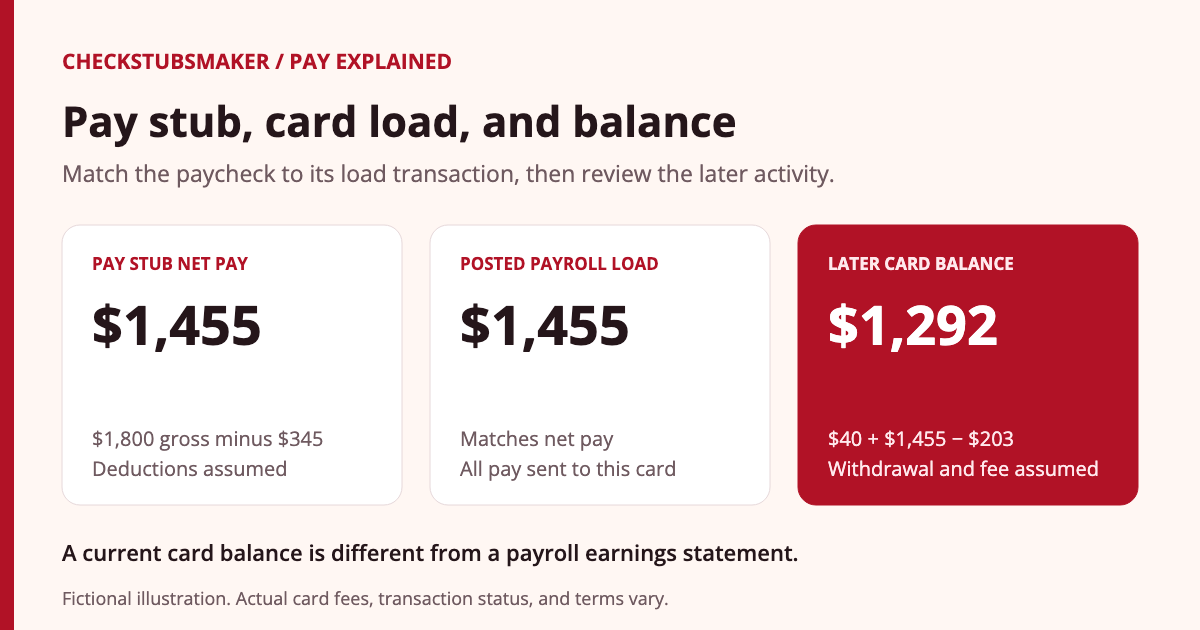
The $1,292 balance does not show a short paycheck under these assumptions. It reflects a correct wage payment plus other activity. Our gross versus net guide explains the payroll calculation before money reaches an account.
What if the payroll load is missing or lower than expected?
First confirm the expected pay date, the load’s status, and the amount assigned to this card. An employer may split a payment between destinations. A card transaction should be compared with its allocation, not automatically with total gross earnings or a YTD figure.
Ask payroll to confirm the payment amount, destination, effective date, and whether it was returned, reversed, replaced, or adjusted. If payroll confirms sending it, ask for reference or trace information that the issuer can use.
Then ask the issuer to investigate the particular transfer. Separate a missing load from a later card fee, withdrawal, purchase, pending item, or unauthorized transaction. Our direct-deposit guide covers related payment-reconciliation steps.
If the wages or deductions themselves are wrong, contact payroll for an official correction. The issuer generally cannot correct the employer’s recorded work hours or wage calculation. See our pay-stub error guide.
Can card fees explain a lower balance, and do you have payment choices?
The CFPB payroll-card fee guidance explains that fees vary by card feature and program. Read the actual disclosures and cardholder agreement. The fictional $3 fee above is not a statement about your card’s price or the lawfulness of any specific charge.
The CFPB also explains that employers cannot require payroll cards as the only payment option. At least one alternative must be offered; state law affects which choices and consent requirements apply. Ask payroll about the actual options and change process.
Changing payment methods does not replace the need for earnings statements. Keep obtaining the employer-issued payroll record after any switch.
How do you get older pay stubs or records after leaving?
Ask the former employer for the missing statements and identify the covered dates. A card issuer may hold payment history while the employer or payroll service holds the earnings breakdown. Our previous-employer guide explains how to make the payroll request.
Use official contact channels and the provider’s identity-verification process. Do not include a card PIN in a pay-stub request. Ask which employee or payment reference is needed to locate the record securely.
If the card or PIN is lost or you see unauthorized charges, the CFPB advises contacting the issuer promptly. That account-protection issue is separate from requesting a missing payroll statement.
What should you keep for each payment?
- The employer-issued pay stub and its payment date.
- The card load’s amount, posting status, date, and reference.
- Any split-payment explanation or payroll correction.
- Relevant transaction history and fee disclosures.
- The written response to an unresolved difference.
Keep current-period figures separate from YTD totals, and use a suitable record-retention period. If an organization requests income documents, confirm what it accepts; a card balance does not automatically substitute for a pay stub.
Frequently asked questions
Can I get my pay stub from the card app?
Check whether it provides the full employer-issued earnings statement. If it shows only transactions, request the stub from payroll.
Should my current balance equal my paycheck?
Not necessarily. Earlier balances, spending, transfers, fees, and pending activity can change it. Match the payroll-load transaction first.
Does being paid on a card remove wage-statement requirements?
Payment method alone does not remove applicable obligations. Check the rules governing the employment.
Who fixes incorrect hours on the statement?
The employer’s payroll process addresses the earnings record. The card issuer handles the card account and its transactions.
Is a card-load receipt enough for an income application?
The recipient determines its documentation requirements. Ask which earnings and payment records it needs.
Prepared by the CheckStubsMaker Editorial Team using the primary sources linked above and original examples. See our editorial policy for sourcing and correction standards. Payroll access, card terms, and legal requirements depend on the actual arrangement.