A payroll register is an employer report that brings together payroll details for the employees included in a payroll run or reporting period. A pay stub explains an individual employee’s payment. Compare the same employee, pay date, earnings, and deductions when reconciling them. The register’s workforce totals should not be mistaken for one person’s wages or for the employer’s entire payroll cost.
For U.S. payroll teams and employees · Sources checked November 16, 2026 · Report layouts vary by provider. The numerical register is fictional, contains no real employee information, and does not calculate payroll taxes.
A register totaling $6,000 gross wages and a pay stub showing $2,000 gross can both be correct. One can cover three employees while the other covers only one. Before investigating a difference, identify the people, payments, dates, and columns included in each record.
How is a payroll register different from a pay stub?
Paychex’s payroll-register overview describes a report that collects employees’ wage and payroll information. ADP’s pay-stub guide describes the individual statement explaining earnings and deductions. Their different scopes explain why their headline totals need not match.
| Question | Payroll register | Individual pay stub |
|---|---|---|
| Whose payroll is shown? | Employees included in the selected report | The employee identified on the statement |
| What is the main use? | Payroll review and reconciliation across the selected group | Understanding one person’s earnings, deductions, and payment |
| Which totals matter? | Employee rows and relevant group totals | Current payment and separately labeled YTD figures |
| Who normally needs it? | Authorized payroll, accounting, or review staff | The employee and an authorized recipient of their record |
Neither title guarantees a particular format. A provider may offer a detailed register, a summary, or a filtered department view. The selected report parameters matter as much as the filename. A report headed “payroll summary” may omit details that appear in a register.
Which fields should you check in a payroll register?
Start with the employer or payroll entity, pay date, covered period, report status, and employee selection. Determine whether the report is a preview or the final processed version. A preview cannot, by itself, establish what was ultimately issued.
For each included employee, identify regular and additional earnings, hours or other units where relevant, employee taxes, other employee deductions, net pay, and any separate employer amounts. Report columns can combine or separate these components differently.
Also check whether the values are current-period amounts or cumulative totals. A YTD tax figure is not another deduction from this payroll run. Our YTD guide explains how overlapping running totals can be counted twice.
Do not infer a missing deduction from an abbreviation alone. Ask for the employer’s code definitions and the complete report layout. Use our deduction-code guide to organize the questions.
Example: matching three employee rows with the payroll total
Assume a fictional completed payroll contains three employees, one cash wage payment each, and no reimbursements, noncash earnings, reversals, or other adjustments. All deductions below are supplied inputs. Employer taxes and employer benefit contributions are excluded from the employee-deduction columns.
| Employee | Gross wages | Employee deductions | Net wages |
|---|---|---|---|
| Employee A | $2,000.00 | $400.00 | $1,600.00 |
| Employee B | $1,500.00 | $300.00 | $1,200.00 |
| Employee C | $2,500.00 | $500.00 | $2,000.00 |
| Payroll total | $6,000.00 | $1,200.00 | $4,800.00 |
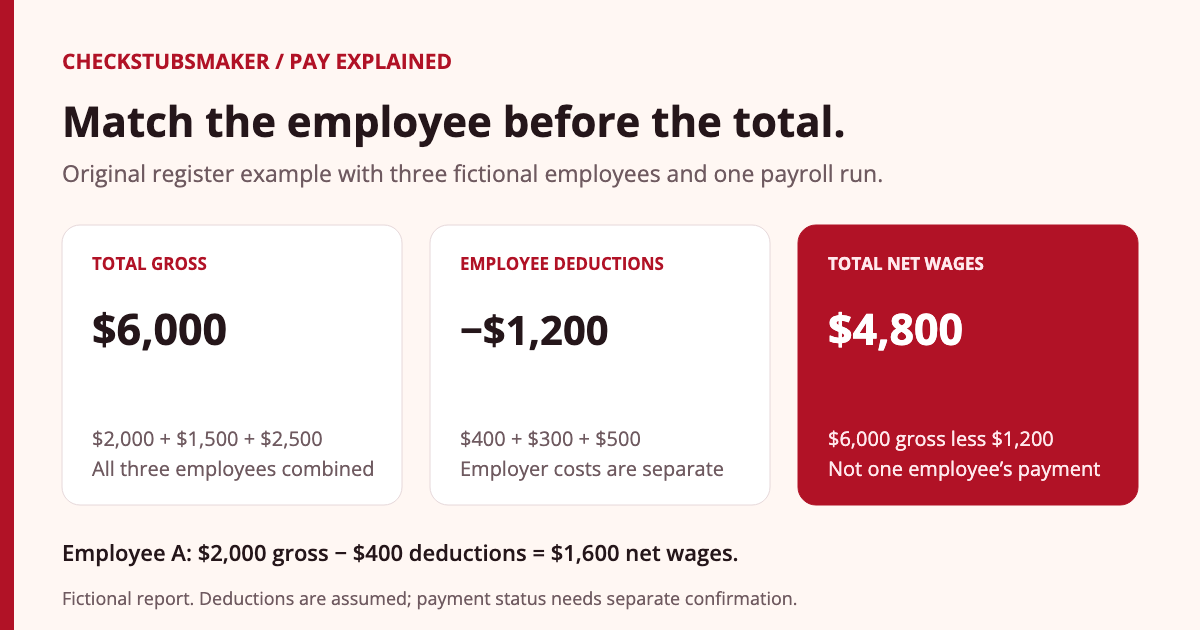
The arithmetic is $2,000 + $1,500 + $2,500 = $6,000 gross, and $400 + $300 + $500 = $1,200 employee deductions. Subtracting gives $4,800 total net wages.
Employee A’s pay stub would reconcile as $2,000 − $400 = $1,600 under these assumptions. Comparing that $1,600 payment with the register’s $4,800 workforce total would mix two scopes. Comparing gross with net would introduce another difference.
The $4,800 is not established as the employer’s full payroll expense or complete bank-funding requirement. Company-paid taxes, benefits, remittances, adjustments, and provider charges require their own records. An informational employer contribution should not be subtracted again from an employee’s wages. See gross versus net pay.
Why might a register and a statement appear not to match?
Compare the report filters first. A register may cover one department, one pay group, selected payment types, or a different pay date. Confirm that both documents concern the same employer and employee before comparing the amounts.
Next identify changes after the original payroll. An off-cycle correction, void, replacement, or additional award can affect the later report. Keep the original transaction and adjustment history rather than assuming every extra row is new recurring earnings. Our off-cycle paycheck guide explains those separate events.
A payment can also be split among accounts. The employee row may show total net pay while one bank statement shows only part of it. A bank withdrawal made to fund payroll can cover different obligations from an employee’s deposit. Match the actual payment records rather than expecting every bank amount to equal one register column.
For a useful reconciliation, record the employee identifier, pay date, gross, employee deductions, net amount, and any adjustment reference side by side. Investigate the first field that differs instead of altering one document to force a matching total.
Should an employee request the entire company register?
For a missing personal statement, start by requesting the employer-issued pay stub or an appropriate individual earnings record. A company register may contain coworkers’ payroll information that is irrelevant to your request.
If an authorized reviewer needs evidence from payroll, ask which employee-specific record or excerpt meets the requirement and how it should be delivered. The existence of a register does not automatically establish that a landlord, lender, agency, or employee must accept it as a substitute statement.
Use the previous-employer retrieval guide for missing records and the sharing and redaction guide when deciding which fields an approved recipient needs.
Does a payroll register satisfy every recordkeeping duty?
No. DOL Fact Sheet 21 explains that covered employers must keep accurate required wage and hour records for nonexempt workers, without prescribing one particular record form. A register may organize some of the information, but supporting time records and calculations can still be necessary.
The fact sheet describes at least three years for specified payroll records and two years for wage-calculation support. The IRS employment-tax recordkeeping guidance has separate requirements, including at least four years for employment-tax records and longer periods for certain credit documentation. These are employer recordkeeping categories, not a universal destruction date for every document.
Keep the final report, its selection parameters, supporting calculations, and adjustment history under the applicable retention policy and rules. For a confirmed discrepancy, request the appropriate payroll correction; see correcting a pay-stub error.
Frequently asked questions
Is a payroll register the same as my pay stub?
No. A register brings together the selected payroll records; your statement concerns your individual payment.
Should my net pay equal the register’s total net pay?
Only compare your payment with the matching employee row. A group total can cover many employees.
Does a payroll register prove that the bank deposit arrived?
Not by itself. Reconcile the processed payroll with the actual payment status and account activity.
Can employer taxes be counted as employee deductions?
Keep employer obligations separate from amounts withheld from employee wages. Confirm the report columns.
Is every payroll register laid out the same way?
No. Provider format, filters, report status, and employer settings affect what appears.
Prepared by the CheckStubsMaker Editorial Team using primary payroll-provider and government sources with an original reconciliation. See our editorial policy.