Build a paycheck budget from recurring take-home pay, actual payment dates, and the bills due before the next payment. Use gross pay to understand earnings, then reconcile net pay with every payment destination. Separate one-time amounts, avoid subtracting payroll deductions twice, and check timing as well as the monthly total.
For U.S. employees · Sources checked November 10, 2026 · All amounts below are fictional planning assumptions. The examples do not prescribe spending percentages, calculate taxes, or determine what an individual household can afford.
A pay stub explains payroll, but a workable budget also needs bank activity, bills, everyday spending, and the starting cash actually available. A month can balance on paper while an earlier bill is still unfunded.
Which records should you gather?
Collect recent statements covering the usual payroll pattern, the upcoming pay calendar, bank or payment-account records, bills, and spending history. Note any correction or change that makes one period unusual.
Consumer.gov’s paycheck guide explains that a pay stub records earnings and amounts taken out for taxes and benefits. It helps explain the payment calculation; account activity helps establish where the payment went.
The CFPB’s Your Money, Your Goals toolkit provides separate income, spending, bill-calendar, and cash-flow tools. That separation is useful: the pay stub is one source in the plan, not the entire budget.
See our reading guide and bank-statement comparison.
Which income figure belongs in a paycheck budget?
Start with the net payment available under the actual payroll arrangement, then identify what part is recurring. Gross wages are not automatically the cash available for household bills.
The CFPB income tracker uses take-home amounts and distinguishes regular, irregular, seasonal, and one-time income. Apply that distinction to bonuses, overtime, reimbursements, and corrections shown on your statements.
Do not treat an unusually large check as a guaranteed recurring amount. If income varies, record the pattern and what is confirmed for the upcoming period. An expected payment and money already available should remain separate entries.
Use the actual calendar. A biweekly annual average is different from the cash received in a particular calendar month. Our pay-frequency comparison and monthly-pay guide explain the schedules.
How do you avoid counting the same money twice?
If health premiums or retirement contributions were already taken out in arriving at net pay, do not subtract them again from that net figure as though payroll had not collected them. Record them separately if you want a fuller picture of compensation and saving.
Also define whether your budget covers the household’s accounts or only the checking account used for bills. A transfer between your own accounts is not a second wage payment.
For a separate fictional illustration, a $1,500 net payment split into $1,300 checking and $200 savings is still $1,500 total. Only $1,300 enters checking. If the $200 already funds a savings allocation, account for it once rather than assuming the full $1,500 is available in checking as well.
Employer contributions displayed for information are not automatically additional cash income. Our gross-versus-net guide and direct-deposit guide explain reconciliation.
Example: organize two recurring payments into a monthly plan
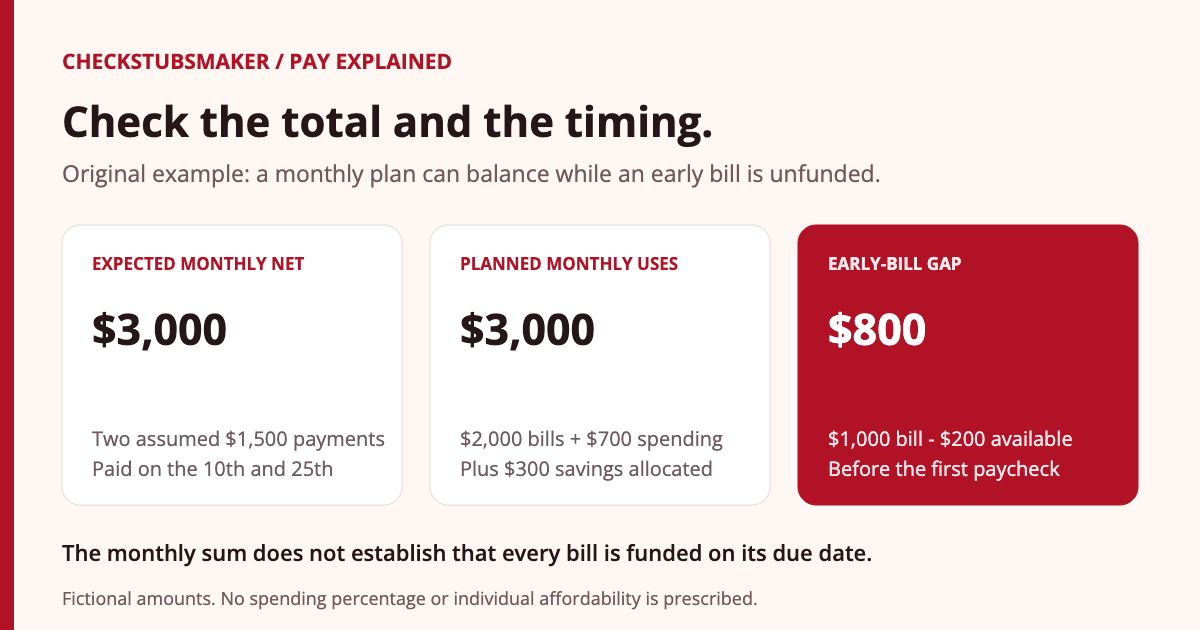
Assume a fictional household expects two regular net payments of $1,500 each, on the 10th and 25th. Assume no other income. The month’s expected payroll receipts total $3,000.
Suppose its proposed uses are:
| Planned use | What it represents | Amount |
|---|---|---|
| Bills and obligations | Assumed documented commitments | $2,000.00 |
| Everyday spending | Assumed month’s spending plan | $700.00 |
| Savings allocation | Money earmarked for saving, not necessarily spent | $300.00 |
| Total planned uses | $2,000 + $700 + $300 | $3,000.00 |
The planned uses match the expected payroll total. That confirms only the monthly addition; the dates still need review. The figures do not establish that this allocation fits another household.
Why can a balanced monthly total still leave a shortfall?
Continue the example with $200 available before the first paycheck and a $1,000 bill due on the 1st, already included in the $2,000 bills category. No other money is available before that bill is due.
| Item | Amount |
|---|---|
| Bill due before the 10th | $1,000.00 |
| Available before that bill | $200.00 |
| Unfunded difference | $800.00 |
The CFPB cash-flow budget tool tracks starting resources, income, and uses over time. It helps identify whether funds are available when needed instead of relying only on a monthly total.
Its bill calendar places income and bill dates together. If a mismatch appears, confirm the biller’s available options before changing a payment plan or assuming a due date can move.
Resolve the actual funding or timing issue before treating the plan as workable. Savings already committed elsewhere, restricted benefits, and an uncertain future payment should not automatically be counted as available for that bill.
How should you maintain the budget?
Compare each actual payment with the expected net amount and record the reason for differences. Update the remaining calendar when hours, deductions, pay frequency, or household obligations change.
Track one-time payments separately from the recurring baseline. Review an unexpected payroll change with the issuer rather than quietly assuming it will repeat. Our correction guide helps document discrepancies.
At the end of the period, compare planned and actual uses and carry forward the actual available balance. The next plan should reflect what remains, not merely the amount you expected to have saved.
Keep the underlying pay statements secure. Our privacy guide explains sharing records when another person needs to review them.
Frequently asked questions
Should I budget bills from gross or net pay?
Use actual available take-home resources for cash planning and understand which amounts have already been deducted.
Should I subtract payroll health premiums again from net pay?
Do not count the same collection twice. Track it separately if needed for a broader compensation picture.
Is an automatic savings deposit extra income?
No. Reconcile it as a destination of the payment, not a second wage receipt.
Does matching monthly income and planned spending prove the plan works?
No. Check whether resources are available before each payment is due.
Can I rely on a one-time bonus as normal monthly income?
Record its actual timing and uncertainty separately from the recurring baseline.
Prepared by the CheckStubsMaker Editorial Team using primary consumer-education sources and original planning examples. See our editorial policy. No individual affordability, tax result, or spending allocation is determined.