On a Pennsylvania pay stub, EIT can identify local Earned Income Tax withheld from wages. Confirm your employer’s code and the locality before applying that meaning. It is a different concept from the federal Earned Income Tax Credit, or EITC. Check the local wage base, applicable rate, residence and work-location records, and the current-versus-YTD column.
Pennsylvania-focused U.S. guide · Sources checked November 10, 2026 · EIT labels are employer-specific. The example uses an assumed confirmed tax base and rate; it does not determine a reader’s municipality, tax rate, exemption, or filing obligation.
Start with the employer’s definition. If the code refers to a different benefit, tax, or jurisdiction, the Pennsylvania explanation below may not apply.
What does an EIT deduction represent?
In the Pennsylvania local-tax context, an EIT deduction is a payroll collection for a local earned income tax. It is not automatically the state income-tax line, federal income-tax withholding, or another local charge.
| Term | Relevant distinction | What to ask |
|---|---|---|
| Local EIT | Pennsylvania local earned income tax in this guide | Which tax jurisdiction and wage base? |
| State income tax | A separate state-tax calculation | Which state and applicable withholding treatment? |
| LST | Local Services Tax, a different local tax | Does a separate LST entry apply? |
| Federal FIT or FITW | Federal income-tax withholding | Which federal wage and certificate inputs were used? |
| Federal EITC | An income-tax credit with eligibility rules | Does the taxpayer qualify under the relevant year’s rules? |
Do not add an employer informational tax amount to employee deductions without confirming its purpose. See our code guide and federal withholding guide.
Why do home and work addresses matter?
The Pennsylvania DCED PSD-code guide explains that six-digit political subdivision codes identify municipalities and help direct local tax payments. Its guidance also describes residency certification and address updates.
Confirm the actual residence and work-location records payroll used, not merely a mailing address or an employer’s corporate headquarters. Use the official address-search resources and relevant tax collector when the location is unclear.
A ZIP code and a PSD code serve different purposes. Ask payroll to verify the actual location and code rather than choosing a rate from a familiar city name.
If you moved, changed worksites, or began working remotely, identify the effective dates and ask how those facts affect the record. Our address-change guide explains why a profile update and a tax-record correction can require separate follow-up.
How is the Pennsylvania local EIT rate checked?
The DCED local withholding FAQ explains the ordinary Act 32 comparison of the total resident EIT rate with the work-location nonresident EIT rate, using the higher rate for the covered situation.
Do not apply that summary blindly to every arrangement. Philadelphia has separate treatment, and temporary assignments, out-of-state work, and other facts can require additional review. Use the applicable official guidance and tax collector for the actual location and payment period.
Check the rate’s effective date as well as the address. A current lookup should not automatically be used to judge a historical payroll without verifying the rate that applied then.
The employer should also identify the correct local wage base. Federal taxable wages, gross earnings, and a local tax base are not interchangeable merely because they appear on the same statement. See taxable wages.
Example: checking an assumed $30 EIT deduction
Assume payroll has confirmed $2,000 of current wages subject to the applicable local EIT and a 1.5% withholding rate for the relevant situation. Assume no credit, reversal, catch-up, or other adjustment.
| Input or result | Calculation | Amount |
|---|---|---|
| Current local taxable wages | Assumed confirmed base | $2,000.00 |
| Applicable rate | Assumed confirmed rate | 1.5% |
| Current EIT withholding | $2,000 × 0.015 | $30.00 |
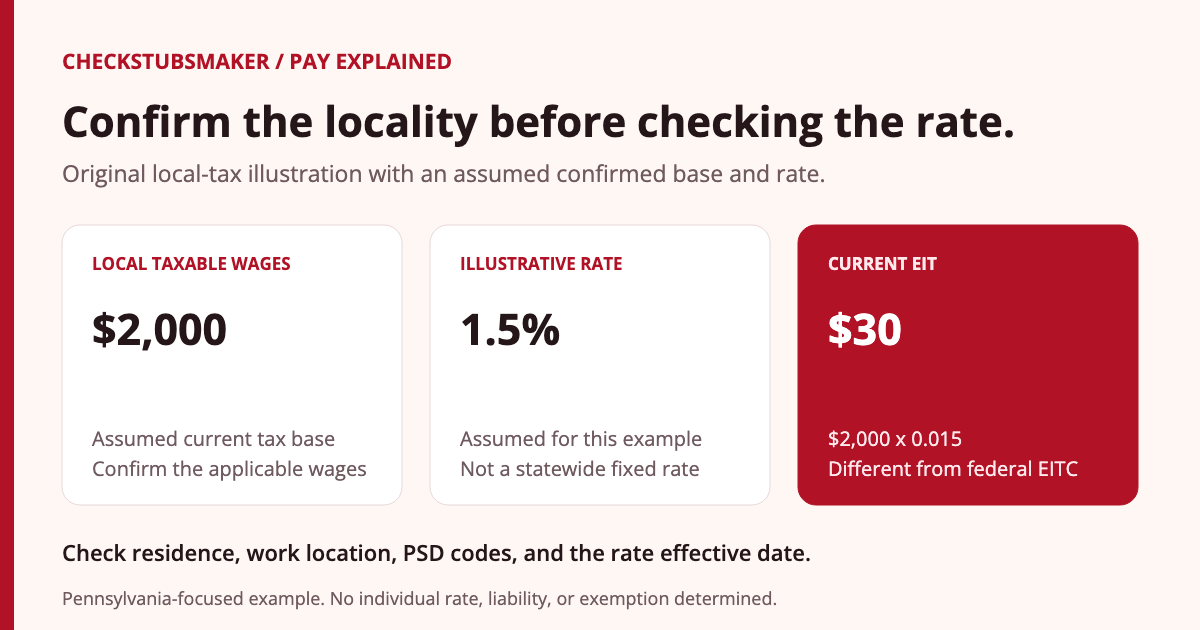
If a real deduction differs, investigate the base, rate, period, and adjustments before deciding it is wrong. Arithmetic can reconcile even when a location or rate was entered incorrectly, so both the inputs and multiplication need review.
This example does not calculate complete net pay or final annual local liability. Our gross-versus-net guide explains how an employee deduction fits within the larger payroll calculation.
Is this the federal Earned Income Tax Credit?
No. The IRS EITC overview describes a federal credit for qualifying workers and families. Eligibility and the amount depend on the applicable tax-year rules and taxpayer facts.
A local EIT deduction does not prove federal EITC eligibility or mean the credit was already paid through that line. Review the federal credit separately using current IRS guidance.
Similarly, the presence or absence of local withholding does not establish whether federal income tax should be zero. See zero federal withholding for that separate issue.
What should you ask when EIT changes?
Compare current and YTD fields, wage-base changes, residence and work-location records, effective dates, and any payroll correction. An increase in gross earnings does not necessarily explain the whole change.
Ask: “Please confirm what EIT means, the locality and PSD codes used, the relevant resident/work-location rate treatment, current taxable wages, and any adjustment included in this payment.”
Keep the residency record and employer explanation. Ask whether the employer or local tax collector needs a correction or additional information, and review any separate filing requirements rather than assuming payroll withholding settles everything.
Our correction guide and YTD guide help organize that review.
Frequently asked questions
Does EIT mean the same thing on every pay stub?
No. Confirm the employer’s code and jurisdiction. This article focuses on Pennsylvania local earned income tax.
Is the example’s 1.5% my local rate?
Not necessarily. Verify the applicable rate and effective date for the actual location and situation.
Is a PSD code a tax percentage?
No. It identifies a political subdivision used in the local-tax process.
Are EIT and LST the same deduction?
No. DCED treats local earned income tax and Local Services Tax as separate taxes.
Does local EIT withholding prove I qualify for federal EITC?
No. Federal credit eligibility must be reviewed separately.
Prepared by the CheckStubsMaker Editorial Team using primary Pennsylvania DCED and IRS guidance plus an original arithmetic example. See our editorial policy. The guide does not assign a jurisdiction or determine an individual’s tax obligations.