A $0 federal income-tax withholding line can be a valid payroll result or a sign that the inputs need review. Check the correct current-period field, federal taxable wages, pay frequency, and Form W-4 information used by payroll. Zero withholding does not by itself mean the wages are tax-free, the employee claimed exempt, or no tax will be due for the year.
For U.S. employees · Sources checked November 10, 2026 · The example assumes ordinary covered employment and a given $0 federal withholding result. It does not determine whether a real employee’s federal calculation or annual tax liability is correct.
First confirm that you are looking at federal income tax rather than a combined tax total, a state tax, or the YTD column. Then investigate the actual calculation instead of choosing an explanation from the amount alone.
Is federal income tax actually zero for this payment?
Read the employer’s code definition. Federal income-tax withholding may appear as FIT, FITW, federal tax, or another label. Confirm whether it is displayed separately or within a combined total.
A positive YTD figure with $0 current withholding means earlier amounts remain in the running total. It does not show that the same amount was collected again on this paycheck. Conversely, a blank label may require an explanation before you treat it as a calculated zero.
Our FITW guide and YTD guide explain the fields.
Which inputs can affect federal withholding?
The IRS withholding overview explains that the amount depends on earnings and the information provided on Form W-4. The payroll calculation also needs the appropriate wage and payment-period treatment.
| Input | What to compare | Why it matters |
|---|---|---|
| Federal taxable wages | Earnings, relevant exclusions, and adjustments | Gross pay is not always the tax base |
| Pay frequency | Payroll calendar and period type | A weekly and monthly payment use different frequency treatment |
| W-4 filing status and entries | Accepted certificate and payroll record | The recorded information affects the calculation |
| Effective date | Date an updated instruction took effect | The newest submission may not govern an earlier statement |
| Payment or correction type | Regular earnings, separate payment, or adjustment | The entry may need its own explanation |
Relatively low taxable wages for the relevant period and applicable W-4 adjustments can produce no federal withholding. That is a possible calculation outcome, not a universal gross-pay cutoff.
Ask for the actual inputs when the amount changes. A changed job schedule, payment frequency, benefit election, or W-4 can require review. See taxable wages and W-4 versus W-2.
Does zero withholding mean you claimed exempt?
No. The number alone does not establish an exemption. Ask payroll whether an exempt instruction is on file or whether its normal calculation produced zero.
IRS Topic 753 explains that exemption from federal withholding requires no prior-year income-tax liability and an expectation of no current-year income-tax liability. It also explains that an exempt certificate is valid only for its stated calendar year.
Do not infer qualification from being a student, working part time, or having no withholding on one statement. Use the current form instructions and the actual tax situation. Our exempt-status guide discusses that separate question.
Example: federal withholding can be zero while FICA is still collected
Assume $1,200 ordinary covered cash wages and a payroll-confirmed $0 federal income-tax withholding result. Assume the employee remains below the Social Security wage limit, no Additional Medicare withholding applies, and there is a $50 after-tax employee benefit deduction. Assume no state or local taxes or other items in this illustration.
The IRS regular employee rates give Social Security of $1,200 × 6.2% = $74.40 and Medicare of $1,200 × 1.45% = $17.40 under those assumptions.
| Entry | Treatment | Amount |
|---|---|---|
| Cash gross wages | Assumed covered earnings | $1,200.00 |
| Federal income tax | Given payroll result | $0.00 |
| Social Security | $1,200 × 0.062 | −$74.40 |
| Medicare | $1,200 × 0.0145 | −$17.40 |
| After-tax benefit deduction | Assumed employee amount | −$50.00 |
| Net payment | $1,200 − $74.40 − $17.40 − $50 | $1,058.20 |
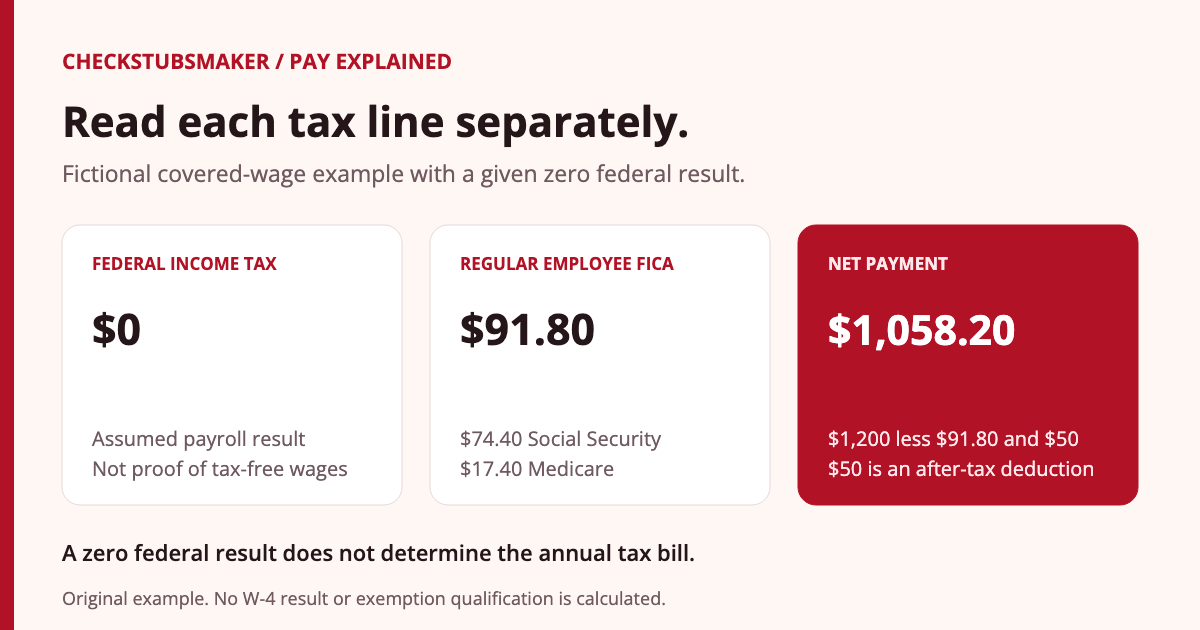
For the separate tax components, see FICA, Social Security wages, and Medicare wages.
Could you still owe tax for the year?
Yes. Withholding is a payment mechanism, while annual liability depends on the complete tax situation. Multiple jobs, a spouse’s income, other taxable income, deductions, and credits can matter.
The IRS Tax Withholding Estimator asks for current pay statements and relevant household and other-income information. Follow its applicability instructions and review the result before deciding whether to submit a new W-4 or obtain advice.
Do not assume that payroll’s correct treatment of one job accounts for every income source. The IRS also recommends rechecking withholding after relevant life or income changes.
What should you ask payroll to explain?
Provide the pay date, period, current federal taxable wages, current withholding, and any recent change. Ask: “Please confirm the frequency, W-4 information, effective date, and any special entry used to produce this $0 federal withholding result.”
If a record was entered incorrectly, ask when it will be corrected and which earlier payrolls need review. Keep the accepted certificate and employer response with the statement. See our correction guide.
Use an accurate current W-4 where a change is appropriate. Do not claim an exemption merely to force a preferred take-home amount.
Frequently asked questions
Does $0 federal withholding mean tax-free wages?
No. The withholding result alone does not establish that treatment.
Can Social Security and Medicare still be withheld?
Yes. They are separate taxes with their own wage bases and rules.
Is there one gross-pay amount below which everyone has zero federal withholding?
No. Review the period, wage treatment, and applicable certificate information.
Does a positive YTD amount mean tax was collected this period?
Check the current column. YTD can reflect earlier payments.
Should I change my W-4 immediately?
First verify the payroll inputs and review the complete tax situation. Correct errors and use accurate instructions.
Prepared by the CheckStubsMaker Editorial Team using primary IRS guidance and an original reconciliation example. See our editorial policy. This guide does not determine a reader’s exemption, withholding setting, or annual tax result.