Review your year-end pay stub by confirming the payment year, checking current and YTD totals, identifying adjustments, and comparing each tax wage base with the matching W-2 field when the form arrives. Also verify personal details, benefit deductions, tax withholding, and access to your records. Gross YTD is not automatically the same as W-2 taxable wages.
For U.S. employees · Sources checked November 9, 2026 · Start with your latest statement and repeat the review after the final relevant payroll. Examples are fictional and assume the stated tax treatment, complete payroll records, and no other adjustments.
A November or early-December statement can help find a problem before year end, but it is not necessarily the final statement. Keep track of later regular payments, separate bonuses, and corrections before treating a YTD figure as the completed annual total.
What should you check on the final pay stub?
| Check | What to compare | Follow-up question |
|---|---|---|
| Identity and delivery | Name, address, employer, and tax-form access | Are payroll and year-end delivery records correct? |
| Payment year | Pay date, work period, and payroll calendar | Which calendar year includes this payment? |
| Completeness | Regular, separate, and corrected payroll statements | Is another payment or adjustment still expected? |
| Current and YTD earnings | Prior total, current activity, and revised total | Does the progression reconcile? |
| Tax wage bases | Gross, federal taxable, Social Security, and Medicare fields | Which inclusions or exclusions explain differences? |
| Withholding and deductions | Tax entries, benefit elections, and contribution history | Are the labels, amounts, and treatment understood? |
| Payment receipt | Net pay and all payment destinations | Do payments reconcile with the statement? |
| Record access | Saved files, portal access, and issuer responses | Can the originals be retrieved when needed? |
Do not add all YTD columns together. Gross earnings, tax wages, deductions, employer contributions, and leave balances describe different things and may use different units. Our reading guide explains the sections.
Does the pay period or the pay date determine the W-2 year?
The IRS W-2 instructions use wages paid during the calendar year. A work period spanning December does not by itself determine the reporting year. Check the actual payment facts and ask payroll about unusual timing.
For an ordinary payroll example, wages for December work paid in January belong to the payment year under that rule. Do not add them to the earlier year solely because the work occurred in December. The pay-date guide explains the date labels.
Also ask whether separate bonus or correction statements are included in the latest YTD totals. A regular statement issued before another payment may not contain the completed annual figures.
How do you reconcile current amounts with YTD totals?
Compare like-for-like fields on consecutive statements. If prior gross YTD is $57,000 and current gross is $3,000, with no other activity or adjustment, the updated gross YTD should be $60,000.
Do not sum $57,000 and $60,000 as though they were separate earnings payments. Those figures are overlapping running totals. Sum current-period amounts or follow the running-total progression, keeping corrections separate.
If an employer switched payroll systems, ask whether the newest statement carries forward the full year or only the new system’s portion. Do not assume a reset total means the earlier wages disappeared.
Keep each employer’s records separate when reviewing multiple jobs. Our YTD guide and annual-income guide help distinguish recorded totals from projections.
Example: why $60,000 gross may not mean $60,000 in federal taxable wages
Assume a fictional employee has $60,000 ordinary covered wages for the year and $3,000 qualifying traditional employee 401(k) deferrals. Assume no other wage exclusions, taxable noncash benefits, or adjustments.
The IRS retirement-contribution FAQ distinguishes federal income-tax treatment from Social Security and Medicare treatment for employee deferrals. Under the assumptions here, the traditional deferral reduces federal income-tax wages but remains included in Medicare wages.
| Figure | Treatment in this example | Amount |
|---|---|---|
| Gross wages | Given annual covered earnings | $60,000.00 |
| Traditional 401(k) deferrals | Assumed qualifying employee contributions | $3,000.00 |
| Federal income-tax wages | $60,000 − $3,000 | $57,000.00 |
| Medicare wages | Deferrals remain included | $60,000.00 |
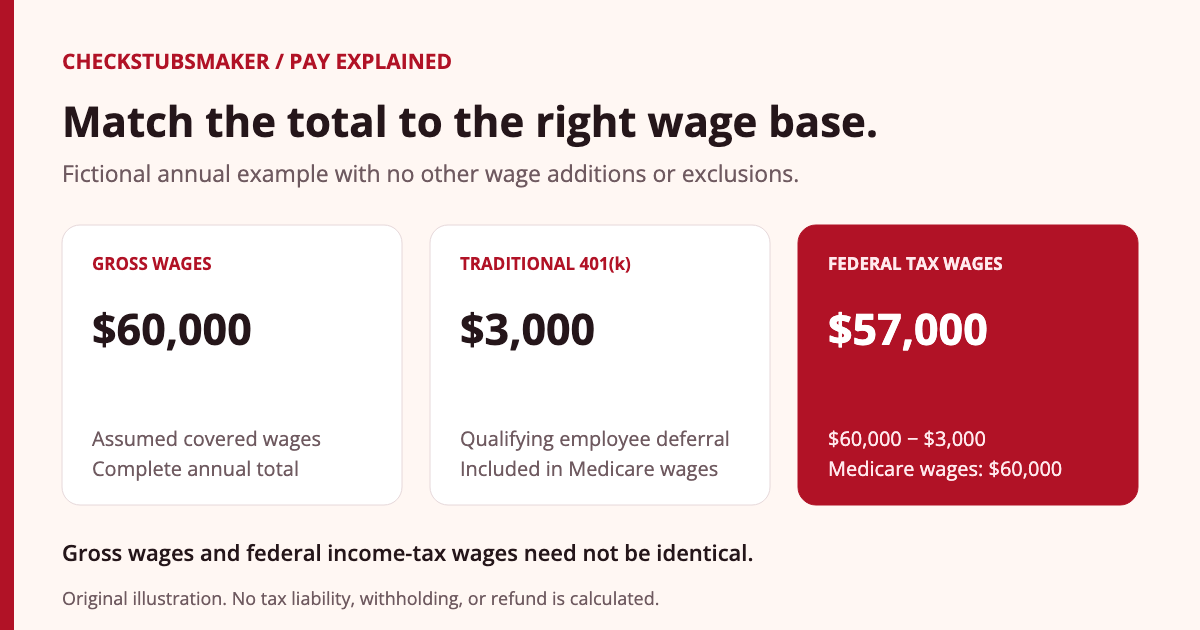
The $3,000 difference is explained by a stated assumption, not by a missing payment. A real record may have additional adjustments, so ask payroll for the actual reconciliation. See taxable wages, 401(k) entries, and Medicare wages.
Which benefits and tax entries need a closer look?
Compare employee benefit deductions with elections and payroll contribution history. Identify employer contributions separately. Check whether a change is recurring, a catch-up, a reversal, or a noncash benefit entry.
Compare retirement payroll deductions with the plan’s contribution records using the relevant dates and explanations. If something differs, ask payroll or the plan administrator which period it relates to rather than assuming every display updates together.
Review federal income-tax withholding using current household information. The IRS Tax Withholding Estimator can help assess withholding; follow its current instructions and applicability. Gather the pay statements and other information it requests, including relevant multiple-job or spouse information.
A single stub does not determine a refund or balance due. Our federal withholding guide explains the payroll entry. Obtain appropriate advice if timing, estimated payments, or a particular tax situation needs review.
What should you compare when the W-2 arrives?
Use the completed annual totals and payroll explanation, not automatically the gross figure from an earlier statement. Compare federal taxable wages with box 1, federal income tax withheld with box 2, Medicare wages and tips with box 5, and Medicare tax withheld with box 6.
Review Social Security and applicable state or local fields as well, using their matching payroll bases. Do not assume every tax uses the same earnings figure or treatment.
If the W-2 differs, identify the exact field, amount, and supporting statements. The IRS missing-or-incorrect-W-2 guidance explains contacting the employer and the next steps when the form is not provided or corrected. Follow the applicable process rather than treating a pay stub as an automatic filing substitute.
What should you save or correct before access changes?
Save complete original statements and year-end forms securely, along with any payroll reconciliation or correction response. Confirm that former-employee access and delivery details will work if you are leaving the employer.
A useful request is: “Please explain the difference between [payroll field and amount] and [annual field and amount] for [year]. Please identify any later payment, carry-forward, exclusion, or correction, and confirm whether a revised statement or form is required.”
See our address-update guide, correction guide, and retention guide for those follow-up tasks.
Frequently asked questions
Is the latest December statement always the final annual record?
No. Check whether later payments or adjustments still need to be included.
Should gross YTD always equal W-2 box 1?
No. Confirm the applicable wage exclusions and additions before comparing the totals.
Should I add all YTD figures from each statement?
No. They are overlapping running totals. Compare the progression or use the appropriate current-period amounts.
Can a final pay stub tell me my tax refund?
Not by itself. A tax result depends on the complete return information and applicable rules.
What if a year-end figure looks wrong?
Keep the source records, identify the exact difference, and ask the issuer to explain or correct it.
Prepared by the CheckStubsMaker Editorial Team using primary IRS guidance and an original annual reconciliation example. See our editorial policy. This checklist does not determine an individual tax result or substitute for the relevant tax forms.